

A school group opens a new campus in June and needs a principal by August. One name comes up quickly: the Grade 8 maths teacher at the flagship school. Her classes have made strong progress for four years, and her colleagues respect her. She says yes.
By December she is spending her evenings on timetables, parent complaints and staffing gaps. She has never led a difficult conversation with a peer about their teaching, and it shows. Back at the flagship school, her old Grade 8 classes are now with a new teacher, and their results are slipping.
She did nothing wrong. The group asked her to do a job she had never practised. It did not gain a principal. It moved a problem.
This is why school groups need a school leadership pipeline: a planned route that identifies, develops, tests and supports future leaders. With a pipeline, the step into leadership is the next of many small steps, not one big jump.
Great Teaching and Great Leading Share a Root, Not a Skill Set
Great teachers and great leaders share something important: a deep focus on whether students are learning, and the habit of checking the evidence.
But the work is different. A great teacher improves learning for the students in front of them every day. A school leader has to improve learning through other adults, in classrooms they rarely see. That takes skills most teachers never get to practise: influencing peers without formal authority, giving honest feedback to colleagues, deciding where limited time and money should go, and judging whether a system is working, not just a lesson.
Being excellent in the classroom is a good sign of leadership potential. It is not proof of leadership readiness. Teacher leadership development is about closing the gap between the two before the title arrives, not after.
What the Research Says About Leaders and Pipelines
Two pieces of US research are useful here.
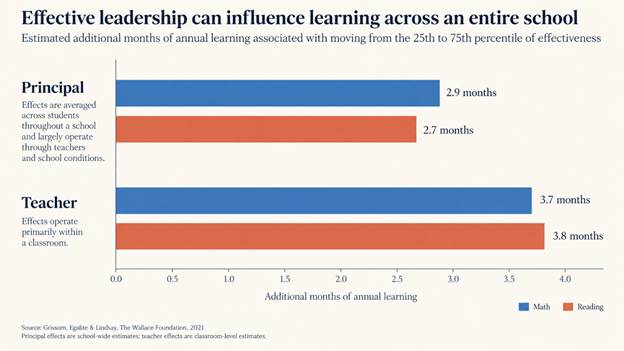
The first is a Wallace Foundation research synthesis on principals. The authors reviewed 219 studies published since 2000, selected from a systematic search of about 4,800 studies. They estimate that replacing a principal at the 25th percentile of effectiveness with one at the 75th percentile raises the average student’s learning by nearly three months a year in maths and reading. Just as useful for our argument: the main way principals affect students is through teachers and by building school conditions where learning can happen. (overview)
The second is a RAND evaluation of the Principal Pipeline Initiative. Between 2011 and 2016, six large districts received funding and support to build systematic processes for managing school leaders. Researchers compared over 1,000 pipeline schools with more than 6,000 schools in the same states that had also appointed new principals. After three or more years, schools with new principals in pipeline districts were ahead of comparison schools by 6.22 percentile points in reading and 2.87 in maths, and those principals were 5.8 percentage points more likely to stay in their school for at least two years. (ERIC -)
Please read these numbers carefully. These were large US public districts, not private or international school groups. The results were not the same everywhere: the effect on maths was negative and statistically significant in one district. The researchers also found that the components appeared to work as a cohesive whole, which means no single element, such as a training course, can claim the credit. RANDRAND
For school-group leaders, the takeaway is not “copy these percentages.” It is that leadership talent can be managed on purpose, and that doing so seems to matter for both students and leader retention.
A Pipeline Is a Series of Stretch Decisions, Not a Training Course
Many groups treat leadership development as a course. Courses help, but people become leaders by making real leadership decisions, with some risk attached and someone checking their thinking. A useful way to design a pipeline is to ask one question at each stage: what decision will this person practise here, and what evidence will they learn to read? As the role grows, the lens gets wider, from one class, to a grade, to a school, and finally to the whole network.
It starts with the expert teacher, who practises adjusting their teaching when students are not learning, using evidence from their own class skill by skill. The sign to look for here is steady progress over several cycles, not one good year. The next step is the teacher leader or mentor, who learns to help a colleague improve without having any formal authority. They begin reading evidence from another teacher’s class alongside their own, and readiness shows when colleagues seek them out and their feedback leads to real change.
At the grade or department level, the decision becomes where to focus a team’s time and intervention. These leaders read results for a full grade or subject across several classes, and the key skill is telling a teaching issue apart from a curriculum or timetable issue. Deputy and assistant principals then learn to resource and follow up whole-school priorities. They work with school-wide results and participation, and the best of them check whether an intervention actually moved anything instead of assuming it did.
By the principal stage, the job is setting direction and building the conditions for learning. A principal reads the school’s results against its own past cycles and against the network, looks at growth before rank, and actively builds leaders below them. Finally, leaders in network or central roles decide how to support each school differently based on need. They compare all campuses on common measures, and a strong network leader knows both how to make those comparisons fair and where their limits lie.
Across every stage, readiness shows up as a behaviour the group can observe, not a feeling in an interview. The deputy principal who plans an intervention, reassesses and honestly reports that it did not work is showing more leadership than the one who presents a polished slide.
There is one caution at the very first stage. Using class results to spot strong teachers is reasonable, but [Future internal link opportunity: tracking student growth across assessment cycles] shows why progress over time is a fairer signal than raw attainment. Even then, a single year’s class results are noisy. Treat them as one lens next to observation and peer feedback, not as a ranking.
Where Pipelines Usually Break in a School Group
Promotion as a reward. Leadership roles are given as thanks for great teaching. The person gets a title, but not the preparation.
The flagship school holds on to talent. Strong campuses quietly keep their best people, so newer or struggling campuses get whoever is left.
Readiness judged by confidence. Interviews reward people who present well. They rarely test whether someone can read a grade’s results and decide what to do next.
No support after appointment. Many groups invest in selection and then leave the new leader alone. The first two years are often where the real development is needed.
Leaders trained apart from their data. Future leaders learn leadership theory, but never practise with the actual assessment evidence they will be expected to act on. Practising [Future internal link opportunity: using assessment evidence to plan interventions] at grade level is better preparation than most workshops.
This raises an uncomfortable question for any group:
If your best teacher becomes an average principal, did the group gain a leader, or lose a teacher?
Five Questions to Audit Your Pipeline This Term
- Do we have written leadership standards that describe what “ready” looks like at each stage?
- How many of our current leaders held a stretch role with real decisions before their promotion?
- When we pick leaders, what evidence do we look at beyond the interview?
- What support do new principals get in their first two years, and who checks it is working?
- Are strong teachers moving to the campuses that need them most, or staying where they started?
And one more, which is the real test of succession planning for school groups: could you name the next five people ready to lead a campus, and show the evidence behind each name? If the answer depends on memory and reputation, the pipeline exists only in people’s heads. A good next step is to look at [Future internal link opportunity: comparing campuses fairly across a school network], because where leaders are placed should follow where support is most needed.
The Promotion Should Be the Least Surprising Step
A good pipeline does not make leadership easy. It makes the promotion unsurprising. By the time a teacher becomes a principal, they have already led a team, supported a colleague, planned and checked an intervention, and explained honest results to people above them. The title recognises work they are already doing.
Your best teachers can become your best leaders. But only if the group builds the road between the two roles, instead of hoping they can make the jump alone.
Where Scholario Ascend Fits
A leadership pipeline asks teachers to read evidence at a wider level with each step. That is closely connected to how Scholario Ascend is designed. The same assessment evidence can be viewed at group, school, grade, class, subject, competency, skill and student level, so a teacher leader and a group director are looking at one evidence base at different levels of detail. School leaders can compare their school against the network and against its own previous cycles, and follow whether an intervention actually moved anything. Group leaders can see which school needs attention by growth and risk, not only by score. What to do about the findings stays a professional judgement, which is exactly the skill a pipeline is meant to build.
FAQs
What is a school leadership pipeline?
It is a planned system for finding, developing, selecting, placing and supporting future school leaders. In a pipeline, leadership grows through a series of roles with real responsibility, not a single promotion.
Should the best teacher always be promoted to leadership?
Not automatically. Strong teaching is a good sign of potential, but leadership requires different skills, such as improving other adults’ practice and managing resources. Test these skills in smaller roles first.
How long does it take to develop a principal from within?
There is no fixed timeline. It depends on the person and the roles available. What matters more is that each step includes real decisions and honest feedback, rather than simply years served.
How is a leadership pipeline different in a school group compared with a single school?
A group can move people between campuses, give stretch roles across schools and compare readiness on common standards. It also carries a risk: strong campuses may hold on to talent that other campuses need more.
What role does assessment data play in leadership development?
Leaders make many decisions based on assessment evidence. Future leaders should practise reading that evidence at a wider level at each stage, from class to grade to school, and deciding what action should follow.