

The Civic Competencies Students Will Need Most in the Next Decade
Many civics programmes do a good job with the basics. Students can name national symbols, describe how the government is organised and list the responsibilities of a good citizen. Those things matter. But look at what the next ten years are likely to bring: economies diversifying away from single resources, AI changing how work gets done, fast-growing cities putting pressure on water and land, and classrooms with many nationalities learning side by side.
In that world, what will a young citizen need to do? That question sits at the centre of any future-ready civic competencies curriculum.
What the evidence suggests
Two international sources are helpful here, with one caveat each.
The World Economic Forum’s Future of Jobs Report finds that employers expect 39% of workers’ core skills to change by 2030. Analytical thinking remains the top core skill, with seven out of ten companies considering it essential. It is followed by resilience, flexibility and agility. The fastest-growing skills include AI and big data, technological literacy, creative thinking, and curiosity and lifelong learning. Caveat: this is an employer survey about work, not civic life. But the worker and the citizen are the same person, and a society needs both roles to reason well.
The OECD’s Learning Compass 2030 names three “transformative competencies”:
creating new value, reconciling tensions and dilemmas, and taking responsibility.
Caveat: it is a framework, not an outcome study. Its value is in the questions it raises for curriculum design.
Put together, the message for civics is clear. Knowledge of institutions is the base, not the goal.
Six competencies worth prioritising
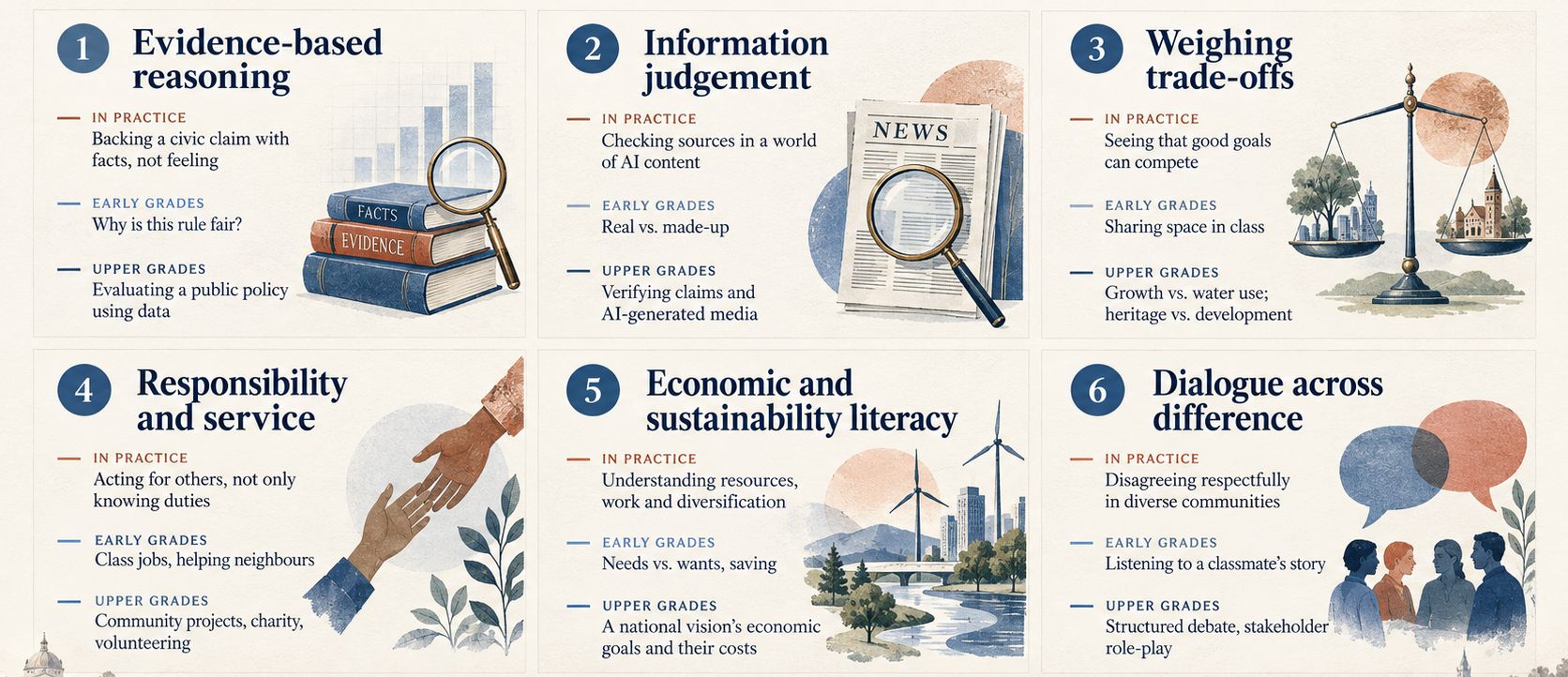
Two of these deserve extra attention.
Weighing trade-offs is where many civics courses stop too early. A new city district brings jobs and housing. It also uses water, changes desert ecosystems and may replace older neighbourhoods. A future citizen does not need to reject development or cheer it without thinking. They need to hold both sides and reason through them.
Information judgement is now a civic skill, not just a digital one. When anyone can produce a convincing video or statement, telling evidence from invention protects public life. This is why media literacy in the social studies curriculum belongs in the civics conversation.
Rooted identity, global outlook
None of this replaces national identity. The strongest civic programmes help students feel secure in their own heritage and confident dealing with the world. A student who understands their country’s history, values and national vision is better placed to contribute to it, especially when they can also reason about trade, climate and international cooperation. See [Blog 45 | Building a Global Citizenship Education Framework That Goes Beyond ‘Cultural Awareness Week’ | Linked text: “global citizenship education framework”].
For how to structure these competencies across K-12, see [Blog 39 | Designing a Civic Education Curriculum That Builds Reasoning, Not Just Recall | Linked text: “civic education curriculum design”].
A question for curriculum leaders:
If a student can explain the goals of a national vision but cannot weigh a single trade-off inside it, is that civic understanding or civic memory?
FAQs
Q: What are future-ready civic competencies?
A: They are the skills citizens will need in a fast-changing society: evidence-based reasoning, information judgement, weighing trade-offs, responsibility, economic and sustainability literacy, and respectful dialogue.
Q: Are workplace skills the same as civic skills?
A: Not the same, but they overlap strongly. Analytical thinking, adaptability and lifelong learning, which employers rate highly, are also what informed citizens need.
Q: Should civics still teach institutions and national symbols?
A: Yes. That knowledge is the foundation. The change is to build reasoning and action on top of it, not to replace it.
Q: How can schools assess civic competencies?
A: Use tasks where students must reason, such as a trade-off decision, a debate position or a community proposal, and assess the quality of their evidence and argument.