

It’s 9:20 on a Sunday night. A sixth-grade teacher has her laptop open on the kitchen table and the dishwasher running behind her.
She opens the curriculum map for tomorrow’s double period. The entry reads: Introduction to loops. Students practice using repeat blocks.
That’s the whole entry.
Everything that decides whether tomorrow works is now hers to invent. How long to talk before the class stops listening. What to do with the four students who have used Scratch since third grade and will finish in eleven minutes. Whether the lab machines updated themselves over the weekend. What the students will actually hand in. And how she’ll know on Tuesday whether any of it stuck.
Nothing in that curriculum map is wrong. It just isn’t finished.
And unfinished curriculum doesn’t stay unfinished. Teachers finish it. In the evenings. One lesson at a time. For free.
We fund training. Monday is a materials problem.
When a school decides to strengthen its technology teaching, the budget line nearly always says professional development. A workshop. A certification. A visiting trainer. A subscription to a community of practice.
All of that is useful. None of it is available at 8:40 on Monday, which is when she needs to know what’s supposed to happen in minute twelve.
Training builds skill over months. Materials decide the next forty minutes. Schools fund the first and assume someone in the room will handle the second.
That assumption is expensive, because the time isn’t there.
In the US Department of Education’s School Pulse Panel, run in December 2023, public schools reported giving teachers an average of 266 minutes of planning time a week. That’s about four and a half hours. Almost half the principals surveyed 47 percent said their teachers get three hours or less. Only 9 percent said five hours or more. The National Council on Teacher Quality’s tracking suggests that number hasn’t moved much in ten years.
Here’s the part that matters for a budget. Every gap left in the material gets paid for in somebody’s evening. A gap that costs a curriculum writer ten minutes to leave costs a department forty teachers’ evenings to fill, every time that lesson runs.
What a lesson plan is actually for
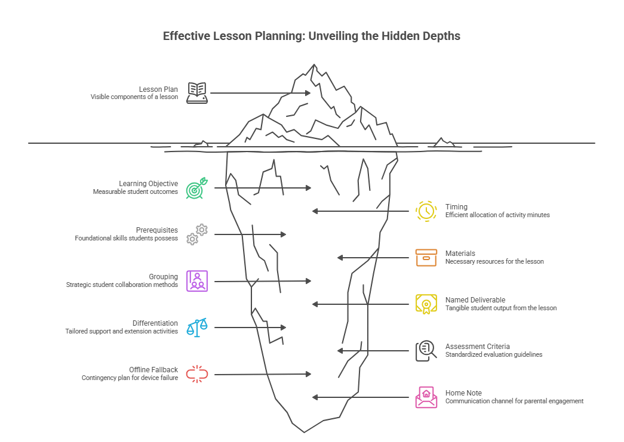
A lesson plan isn’t paperwork. Every part of a good one is there because something specific goes wrong when it’s missing.
Read this as a list of prevented failures, not a list of headings.
| Component | What it has to say | The failure it prevents |
| Learning objective | Something a student does that you can see | “We covered loops,” with no way to know who can use one |
| Timing | Minutes per activity, not per lesson | Fifteen dead minutes before the bell |
| Prerequisites | What students must already be able to do | Quiet reteaching nobody budgeted for |
| Materials | Everything needed, including the non-digital things | A scramble for cables at 9:02 |
| Grouping | Whole class, pairs, groups, alone and when to switch | Transitions that eat a third of the period |
| Named deliverable | What each student leaves with | A cheerful lesson that produces no evidence |
| Differentiation, both ways | An extension task and a support route, written out | Fast finishers derailing the room; stuck students going silent |
| Assessment criteria | Levels another teacher would apply the same way | Grades that drift between sections and between years |
| Offline fallback | A version that works with no working device | A period lost to an outage |
| Home note | One line a parent can ask a question from | Learning that stops at the classroom door |
The prerequisites row is different from the others, and it’s worth a moment.
A missing material breaks the lesson in the first five minutes, loudly, in front of everyone. A vague objective does the same. You find out fast.
A missing prerequisite never announces itself. It just turns into reteaching. Quiet reteaching is a sign that a prerequisite was assumed instead of written down. It is not a sign that the students are behind.
None of this is unusual to want. What’s unusual is finding all of it already written in the material a teacher is handed rather than built by the teacher from a topic heading, a search engine and eight years of experience.
And it isn’t written anywhere, which means it isn’t shared anywhere either. Four teachers run that same loops lesson in the same week. All four decide how long the explanation should be. All four invent something for the fast finishers. None of them compare notes, because there’s no document to compare notes against.
That isn’t a knowledge problem. It’s the same work being done four times, every week, by people who are already short of time.
The cold start test
Picture Thursday. Your best CS teacher is home with flu. Someone is covering her class.
That’s the whole test, and you don’t need an audit framework to run it. One question, applied to any lesson in the curriculum map:
Could a capable teacher who has never taught this lesson deliver it tomorrow, after fifteen minutes of reading and no other prep?
Five checks decide it:
- Can they state the objective in one line, without having to interpret it?
- Do they know what should be happening in minute twelve?
- Is every material listed and actually in the room?
- Is there something written down for the student who finishes early, and for the one who can’t start?
- Can the lesson still run if nothing loads?
Five yeses means anyone on the team can teach it. One no means the plan isn’t finished. The teacher is finishing it, and the cost has moved off the page and into her Sunday.
Run it on three lessons. Not the showcase unit pick an ordinary week in the middle of a term. The result will tell you more about where your department’s workload actually sits than any staff survey will.
“Isn’t that just a script?”
Someone always raises this in the meeting, and they’re right to. Over-detailed material can turn into a script, and a scripted teacher is worse than one who improvises.
So here’s the line.
A good plan fixes what: the objective, the prerequisites, the deliverable, the assessment standard. Those have to match across a department or the progression falls apart.
It leaves the teacher how: the explanation, the analogy, the pacing, which group to sit with, which student to push today.
Timings are budgets, not orders. A teacher who spends twenty minutes on a concept because the class needed twenty minutes is using the plan correctly, not breaking it.
The test is simple. If the material tells a teacher what to say, it has crossed the line. Prevention belongs in the plan. Performance belongs to the teacher.
Why a shape beats a library
Schools often measure teacher support by volume. Hundreds of resources. Thousands of assets.
Volume is easy to advertise and does almost nothing for Monday. A teacher staring at a search box at 9pm isn’t short of material. She’s short of the one thing that fits this class, this week, at this point in the sequence.
What actually cuts the load is a repeatable shape. When every lesson follows the same flow, a teacher learns the shape once and only has to learn the content after that. A new hire is useful in two weeks instead of a semester. A sub lesson is survivable. And a department head can look at two teachers in two sections and see the same structure underneath which is the only honest way to have a conversation about consistency.
A hundred well-built lessons beat a thousand loose assets. It isn’t close.
How KODEIT approaches this
KODEIT’s lesson plans are built on the C.L.A.S.S. flow Connect, Learn, Apply, Sort and Compare, Show and Share. Every lesson in the program has that same shape: prior knowledge first, structured teaching second, hands-on work third, analysis and comparison fourth, and a finish where students present, teach or submit what they made.
Underneath the flow, the published plans carry the parts listed above rather than assuming them: a stated objective, materials, grouping, a named deliverable, timings per activity, differentiation for advanced learners and for students who need more support, rubrics, technology options, homework and a note for talking to parents.
The teacher resources are organized by what a teacher is doing at the time planning, teaching or assessing instead of by file type. That’s the difference between a resource hub and a filing cabinet, and it’s the kind of small decision you only notice at 9:20 on a Sunday.
The material is also mapped to recognized standards, including the ISTE Standards for Students, so what a teacher delivers on Monday connects to something a curriculum leader can report on in June. Mapped, to be precise about it not endorsed.
That’s all the phrase everything a teacher needs for Monday morning is meant to claim. Not more material. Material specific enough that a teacher’s prep time goes into her class instead of into finishing someone else’s curriculum.
Where to start
Open next week’s lesson an ordinary one and run the five cold start questions against it.
Whatever the plan doesn’t answer is work your department is already doing for free, every week. It’s also the most reliable list you’ll get of what to fix first, and it cost you nothing to produce.
The question worth putting to your next curriculum meeting isn’t whether teachers need more support. It’s narrower than that, and more useful:
Are we asking our teachers to deliver a curriculum, or to finish writing one?
Frequently asked questions
What should a computer science lesson plan include? An objective you can observe, prerequisites, a materials list, timings per activity, grouping, a named student deliverable, differentiation in both directions, assessment criteria, and a fallback that works without devices. Each one prevents a specific classroom failure. None of them are there to satisfy a template.
How much prep time do teachers actually get? US public schools reported an average of 266 minutes a week in the Department of Education’s School Pulse Panel, run in December 2023. Nearly half of principals said three hours or less; only 9 percent said five hours or more. Reliable figures for computer science teachers on their own are hard to find.
Is a detailed lesson plan the same as a script? No. A plan should fix the objective, prerequisites, deliverable and assessment standard, because those need to match across a department. Explanation, pacing, analogy and grouping stay with the teacher. If the material tells a teacher what to say, it has gone too far.
What is the C.L.A.S.S. framework? KODEIT’s flow for every lesson: Connect (activate prior knowledge), Learn (structured teaching), Apply (hands-on practice), Sort and Compare (analysis), and Show and Share (students demonstrate what they made).
How do I tell whether a curriculum will really cut teacher workload? Run the cold start test on an ordinary mid-term lesson, not a showcase unit. If a teacher who has never taught it could deliver it after fifteen minutes of reading, the workload is in the material. If not, it’s in your staff.
We already spend on professional development. Should we stop? No. They do different jobs. Training raises what a teacher can do over a year. Materials decide what happens in the next forty minutes. If your PD budget has no line for what a teacher holds in her hand on Monday, the budget is incomplete not wrong.