
A class of four-year-olds spends a week on community helpers. They colour a firefighter, match a nurse to a clinic and sing the helpers song. On Friday a delivery van reverses into the school gate, and most of them barely look up.
The unit was about the real world. It was never connected to it.
That gap is where real-world application in preschool curriculum design gets decided. Most programmes already choose familiar themes. The harder question is whether children get a reason and a way to use an idea in a real setting, and whether the teacher knows what to look for when they do.
A theme is not an application
What does real-world application mean in preschool curriculum design?
It is the planned moment when children use a concept in a familiar, meaningful setting, such as a role play, a map, a family task or a classroom routine. The teacher also knows what evidence would show the idea has taken hold. It goes further than choosing everyday topics.
Curriculum teams often audit for topics: does the unit mention community, food or weather? A better audit asks what the child actually does. If a unit’s link to daily life lives only in its title, what has the child applied?
| Design question | Real-world as a theme | Real-world by design |
| Starting point | A topic that sounds familiar | A concept plus a setting children already meet |
| What the child does | Listens, colours, matches | Uses the idea: builds, sorts, role-plays, explains |
| What the teacher sees | Finished pages | A strategy, a reason, a change over time |
| Link to objective | Loose, often implied | Named before the activity begins |
| Return visit | Rare; the unit moves on | Planned in a new setting later |
What two recent studies suggest, and where they stop
Two recent studies researchers help here. Both have limits.
In the first, educators and directors from six early childcare centres co-designed playful activities aimed at STEM or literacy skills. Observations showed the activities encouraged more STEM and literacy language between teachers and children, and children at the literacy-focused centre later outscored children at the STEM-focused centre on a vocabulary assessment. (Pesch et al., 2025) Six centres is a small sample, so this is early evidence, not proof. My reading is that an activity built around a named goal tends to produce language that follows that goal.
The second study randomly placed 331 US preschoolers in a usual-practice control group or one of six spatial training groups, some using concrete materials and some digital. All six trainings improved the trained spatial tasks, and overall spatial skills rose, most clearly for children with lower parental education. Carry-over to overall maths was much weaker. (PubMed)
That last point matters for design. An activity can work on the skill it practises and still not carry over on its own. If learning transfer in early childhood is the goal, the curriculum has to plan for it and look for it.
Building application into the unit, not onto it
Start with the concept, then find where children already meet it. Sorting shows up at tidy-up time. Position words turn up on the way to the playground. The setting should be one the child recognises, which raises a fair question: whose real world is the curriculum assuming? A unit on “my home” that shows only one kind of house or family leaves some children translating before they can think. That is why family identity and belonging is a design issue, not just a values statement.
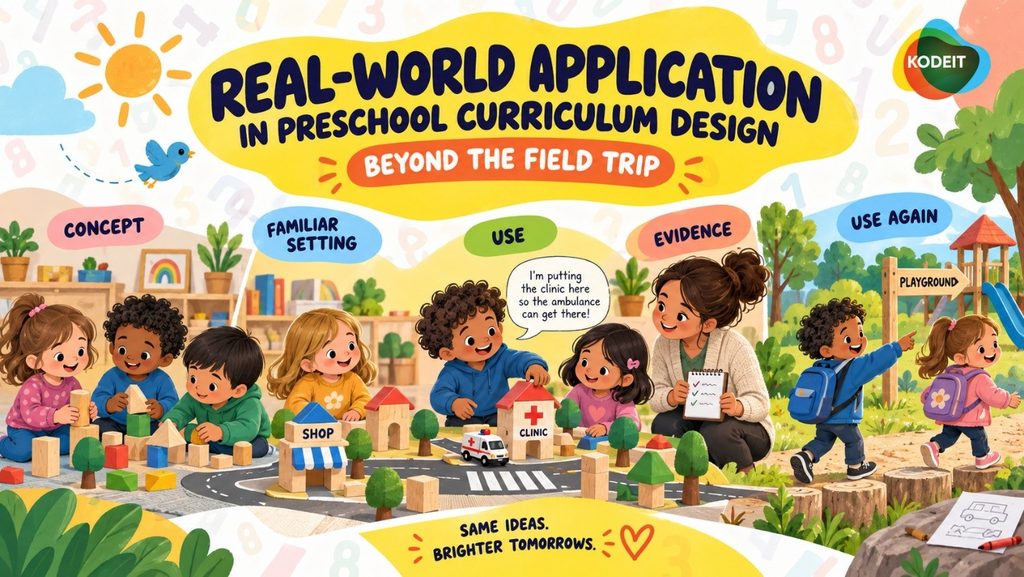
Next, plan what the child does. Say a group builds a neighbourhood with blocks, and a teacher hears one child explain, “The clinic is next to the road so the ambulance can get there fast.” The evidence is not that the map looks right. It is the reason the child gives. That only counts if the unit had a clear objective to hold it against, which is the point of aligning assessment with learning objectives. It is also why evidence of learning through play should be decided before the activity, not pieced together afterwards.
Then plan the return trip. One visit rarely secures an idea. Come back to it weeks later in a new setting and compare how children explain it. Pre- and post-unit observation makes that change easy to see. Across levels, the setting should widen from home and classroom to neighbourhood and beyond. That is what citizenship progression and community learning look like when they are built across a programme instead of one unit.
Safety is a useful stress test. A child can recite a rule and still be unsure at a crossing, so community safety themes probably need calm, realistic rehearsal, not repetition alone.
For curriculum leaders, three practical checks follow. Can two teachers using the same unit agree on what evidence counts? Does the added real-world work replace something, or just add workload? Can someone reading the plan see which objective each application moment serves?
The question worth carrying back
The more useful question may not be whether a unit is about real life.
It may be what a child could do the following week, unprompted, that shows the idea travelled with them.
Where KODEIT Pre-K fits
Curriculum design is where an idea like this becomes routine or stays a slogan.
Across the levels. Book 2 in each level (Exploring My World) widens the community context. Level 1 covers community helpers, safety and nature. Level 2 covers community roles, teamwork and conservation. Level 3 moves to leadership, problem-solving and global citizenship.
Inside each lesson. The lesson flow includes a concept application step built on role play and movement. The PLAY framework closes with a real-world connection and a home-school suggestion.
Around the lesson. Practice Books invite children to bring in their own experiences, such as family pictures, daily routines and familiar foods. Teacher Books pair assessment and observation tools with home connection ideas.
FAQs
Does real-world application mean more field trips?
Not necessarily. Trips can help, but corridors, snack routines and playgrounds can host planned application too.
How can a teacher tell application from simple enjoyment?
Look for change rather than cheerfulness: a new strategy, an explanation in the child’s own words, or the idea turning up in a different activity. Note it against the unit objective the same day.Is this realistic for three-year-olds?
Yes, if “real world” means their world: family, routines, the classroom, the street outside. The setting widens, and the expected explanation grows, with age