
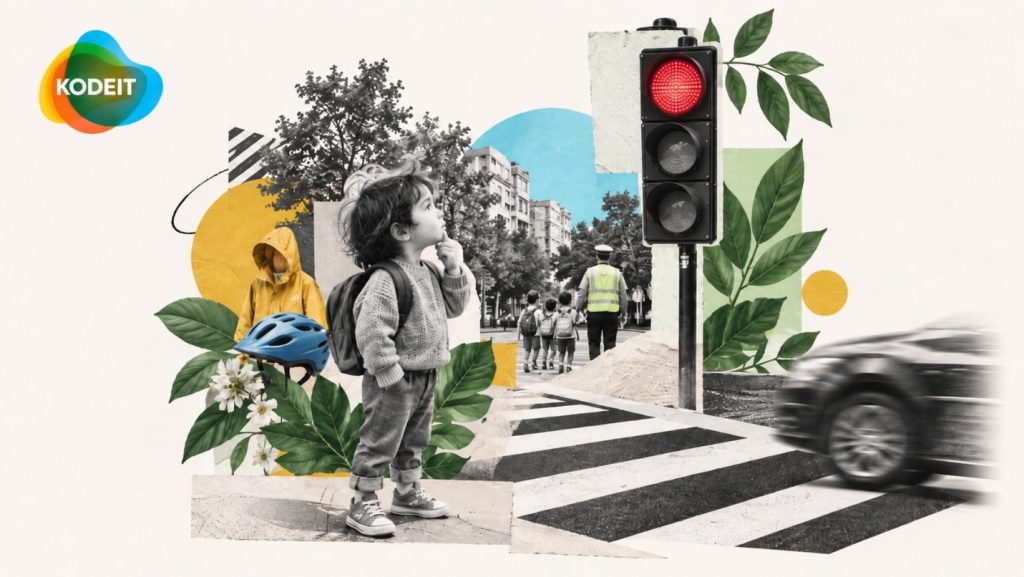
On a short walk to the neighbourhood park, a teacher asks her four-year-olds why the cars have stopped at the crossing. One child says, “Because the light is red.” Another says, “Because we are small.” A third says nothing and holds her friend’s hand a little tighter.
Three children show three different levels of understanding, and a safety poster would have recorded none of it. That gap is the real design problem behind community safety themes in preschool programmes. Teaching a rule is easy. Knowing whether a child understands what the rule is for is much harder.
Why community safety themes in preschool programmes need more than a safety week
Many programmes treat safety as a one-off event: a fire engine visit, a poster, a song about crossing the road. These are good moments. But they can leave children with a list of instructions and no sense of cause and effect.
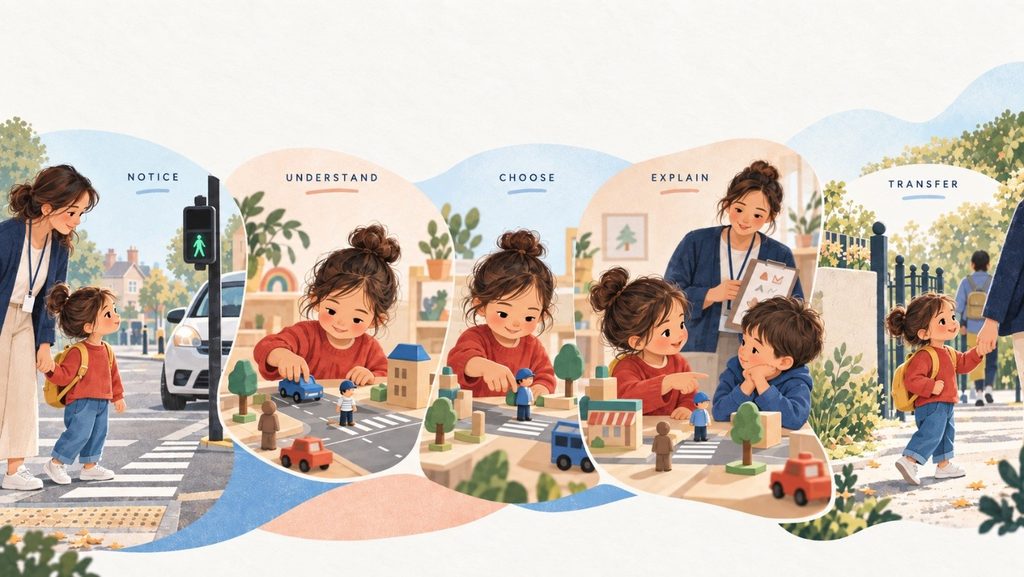
The more useful question may be whether a child can explain, show or choose what to do, and then do it in a slightly different situation. That turns safety from a topic into a thread that returns each year with more depth. It also links directly to community learning, because young children make sense of safety through places and people they already know the crossing outside school, the clinic, the firefighter, the park.
What evidence can and cannot tell us
CDC reports that drowning is the leading cause of death for US children aged 1 to 4, and that formal swimming lessons and proper pool fencing can reduce the risk. CDC also notes that drowning can happen in seconds and is often silent. My reading is that most of this protection comes from adults, fences and lessons. So a water-safety theme should build awareness and vocabulary, not hand a four-year-old the responsibility for staying safe. (CDCCDC)
Witte and colleagues worked with 148 first- and second-grade students from one public school. All received the same safety lesson, then were randomly placed in a colouring group or a group using a small magnetic model of roads, crossings, signs and vehicles. The hands-on group gained significantly more safety knowledge, and first-graders in that group improved by about 17 points on average, against about 7 for the colouring group. (DOIDOI)
A working map of safety themes
Looking for evidence without frightening children
Safety is one of the few themes where assessment can go wrong emotionally. If children feel tested on danger, the lesson turns into fear. The evidence should come through play instead: a role-play where the alarm sounds, a drawing of “my safe place”, a choice between two pictures. This is where evidence of learning through play and low-pressure assessment become practical.
Picture a fire-alarm role-play. A child who used to follow the crowd now stops at the “door”, waits for the teacher’s signal and tells a friend to wait too. The evidence is not that she “knows fire safety”. She is using a rule in a new moment.
If a child can recite a rule but cannot show what they would do, what have we actually recorded? And are we teaching children to be careful, or teaching them to be afraid?
Who carries the responsibility in each activity, the adult, the environment or the child?
Where KODEIT Pre-K fits
KODEIT Pre-K places safety inside its community and weather themes instead of a single stand-alone topic.
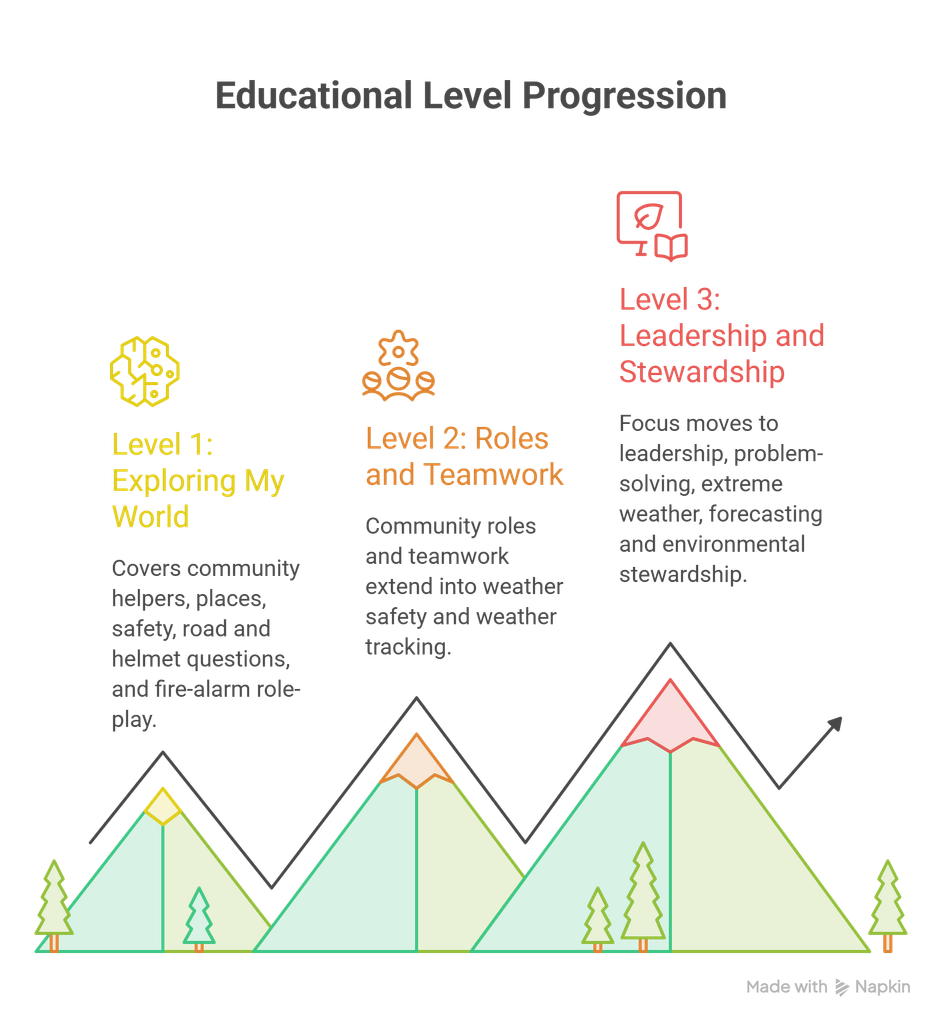
Level 1 (ages 3–4): Exploring My World covers community helpers, places and safety. The Level 1 NGSS-enriched mapping frames road and helmet questions as cause and effect and suggests fire-alarm role-play.
Level 2 (ages 4–5): community roles and teamwork extend into weather safety and weather tracking.
Level 3 (ages 5–6): the focus moves to leadership, problem-solving, extreme weather, forecasting and environmental stewardship.
Each Teacher Book also includes Assessment & Observation notes and Home Connection Ideas.
The question worth carrying forward
The strongest safety themes may be the ones children barely notice as safety lessons. They look like walks, maps, role-play and conversation. If a programme can show how a child’s thinking grew across a year, it is doing something a poster week cannot. What would you need to see to believe a child understands why, not only what? That question belongs to the whole early years assessment framework, not just one unit.
FAQs
What are community safety themes in preschool programmes?
They introduce young children to how people and places keep a community safe: crossing roads, responding to alarms, staying safe in sun, water and weather, and knowing which helpers to turn to. In a good programme, children explore these ideas through play, role-play and conversation rather than lists of prohibitions.
How can teachers assess safety learning without testing?
By recording what children say and do in role-play, drawings, sorting tasks and short conversations, then comparing across time. The context matters: a response in a familiar game is not the same as a response in a new situation.
Should preschoolers be responsible for their own safety?
Programmes should be careful not to suggest it. The CDC information above points to fences, supervision and lessons as the real protection. Children can build awareness and habits, but adults hold the responsibility.
How can families be involved?
Through short home ideas that mirror the theme, such as spotting road signs on the way home or choosing clothes for the weather. Families also bring their own routines, which connects to family identity and belonging.