
The usual adoption process looks like this. A publisher gives a strong presentation. The committee sees a few beautiful sample chapters and an alignment spreadsheet with every box ticked. A decision is made.
Two years later, teachers are skipping the inquiry sections because the pacing doesn’t allow them. Grade 7 repeats Grade 5 with longer paragraphs, and the unit tests are almost entirely multiple choice.
None of this was visible in the sample chapters. All of it could have been found with a better review.
Why this decision deserves more care
Curriculum choice is one of the few decisions that shapes every lesson for years. Researchers at the Brookings Institution argued that there is strong evidence that the choice of instructional materials has large effects on student learning, effects comparable in size to differences in teacher effectiveness. They also found that little research exists on the effectiveness of most materials, and little systematic information is collected on which materials schools actually use. On alignment, they warned that publishers were declaring alignment with new standards using very superficial definitions. (0410 curriculum chingos whitehurst )
One caution is important here. Most of that evidence comes from maths and reading. Research on social studies materials is much thinner. In our view, that makes a careful local review more important, because there is less outside evidence to rely on.
Five common traps
Mistaking coverage for coherence. Every topic appears somewhere, but nothing builds from one year to the next.
Taking alignment claims at face value. Ask for mapping at the lesson level, not the unit level. Also ask what a claim actually means. “Mapped to” a standard is not the same as “approved by” the body that wrote it.
Judging by the best chapter. Publishers show their strongest units. Review a mid-year unit from a middle grade instead.
Accepting “inquiry” as a label. Check whether the lesson questions are actually investigated, or answered on the same page.
Ignoring the teacher experience. A programme teachers cannot deliver in the time available will not be delivered.
The checklist
| Sr. | Area | Questions to ask | Red flag |
| 1 | Purpose | Does it state what kind of thinker it aims to develop, and is that visible in the tasks? | A mission statement with no link to what students do |
| 2 | Standards | Is alignment shown lesson by lesson? Does it cover practices (evidence, argument), not just content? | Unit-level ticks; practices missing |
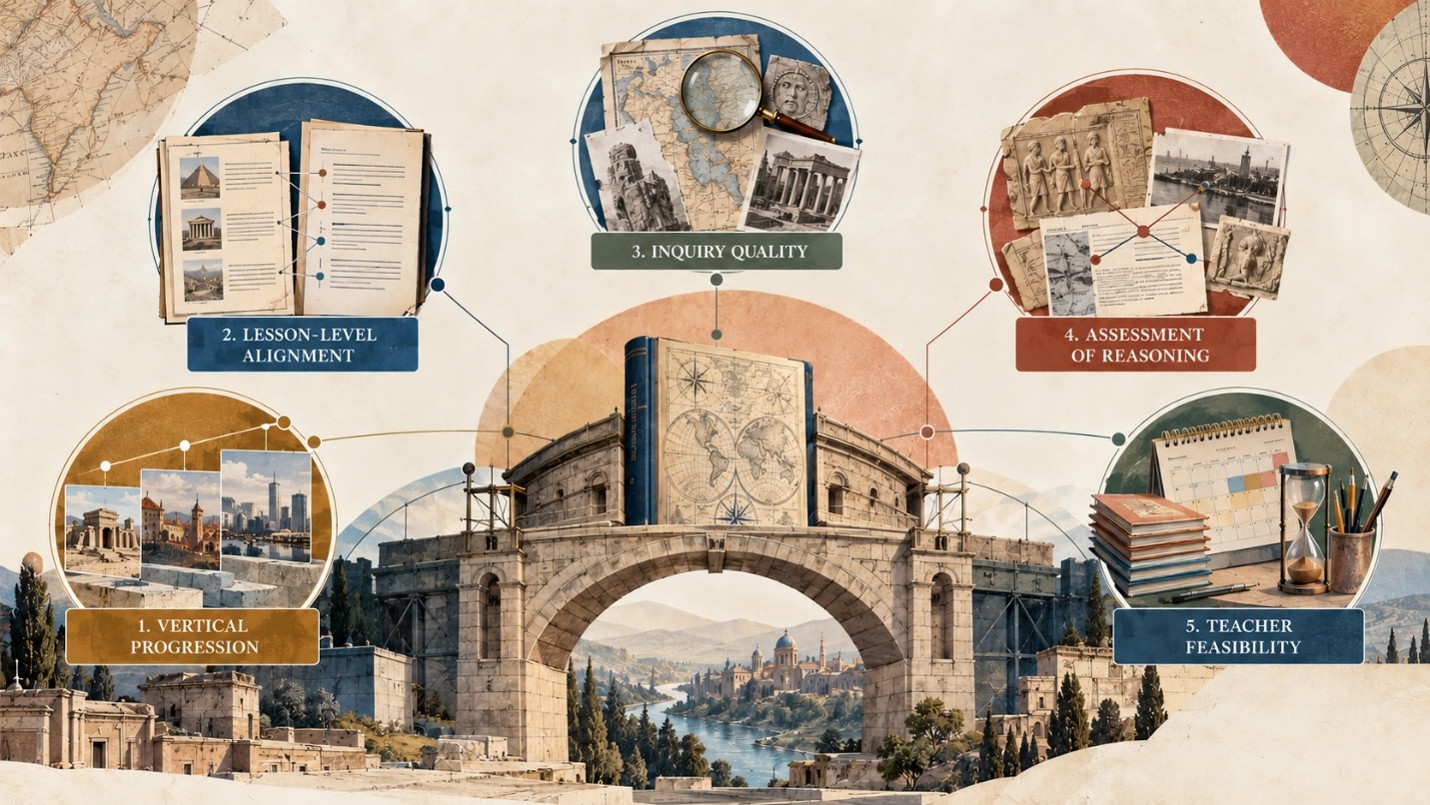
| 3 | Vertical progression | Trace one concept (rights, trade, change over time) across three grades. Does the demand grow? | The same activity type repeated every year |
| 4 | Disciplinary balance | Are history, geography, civics and economics each taught with their own ways of thinking? | Civics or economics as a few add-on pages |
| 5 | Inquiry quality | Do lessons begin with real questions, with sources to investigate? | Questions answered in the next paragraph |
| 6 | Sources and perspectives | Are there primary sources, maps and data, and more than one view where people genuinely disagree? | One narrative; images used only as decoration |
| 7 | Assessment | Do tasks ask for claims and evidence? Do rubrics score reasoning? | Nearly all multiple choice; rubrics weighted toward neatness |
| 8 | Context and localisation | Does it connect to students’ own state, country and community in depth, beyond swapping names? | Only surface changes to names, flags or currency |
| 9 | Teacher support | Are there pacing guides, guidance on running inquiry, differentiation and training? | A teacher guide that is mainly an answer key |
| 10 | Feasibility | Does the pacing fit your real teaching time? | Content that needs far more hours than your timetable allows |
| 11 | Digital resources | Do they deepen learning or just repeat the book? | Videos that read the textbook aloud |
Areas 3, 5 and 7 are where programmes differ most, and where sample chapters reveal least. For more detail, see vertical progression in Social Science[13], questions that connect disciplines[20], assessments that measure reasoning and rubrics built around disciplinary reasoning[50]. For area 8, see why localisation is more than changing place names[53].
If you traced the idea of “rights” from Grade 2 to Grade 8 in this programme, would you see students’ thinking grow, or the same page reappear?
A review process that works
Form a small team that includes classroom teachers, not only leaders. Agree on a scoring scale (for example, 1–4 per area) before seeing any materials, so strong presentations don’t set the standard. Trace one concept vertically across at least three grades. Teach one real lesson from a mid-year unit and note what teachers had to add or skip. Talk to schools already using the programme, and ask what they changed after the first year.
Before the final meeting, agree on one thing: what evidence would change your decision? This keeps the review honest.
The bottom line
A curriculum adoption is a multi-year commitment made in a few weeks. A structured review cannot remove all the risk, but it replaces first impressions with evidence. That is a better basis for a decision this large.