

Most provider comparisons go the same way. Three or four publishers send sample books. A committee meets for an afternoon and turns the pages. The series with the cleanest layout and the brightest maps usually wins. A few months later, teachers find that Grade 4 repeats most of Grade 3. The teacher guide turns out to be an answer key. The “local content” is a flag on the cover and a chapter at the back.
A sample chapter shows a provider’s best lesson. It rarely shows how the curriculum holds up across eight or twelve years, or what a teacher does with it on an ordinary Tuesday. That is why comparing social studies curriculum providers needs a framework: one set of questions, applied to the same evidence, for every provider on the list.
Why do side-by-side comparisons so often go wrong?
Usually because the providers set the terms. Each one presents its strengths in its own format. One leads with digital resources, another with teacher training, a third with standards. The committee ends up comparing presentations instead of curricula.
A second problem is that reviewers look for different things. The head of department reads for content accuracy. The principal thinks about how parents will see it. A teacher asks, “Can I teach this tomorrow?” All three views matter, but without shared criteria the decision goes to whoever argues hardest.
The fix is simple to describe and harder to do: agree your criteria before anyone opens a sample, and ask every provider for the same documents.
What should the framework actually compare?
The table below is a starting framework. It works alongside the broader checklist on [Blog 12 | How to Evaluate a Social Studies Curriculum Before Adoption: A Practical Checklist | Linked text: “how to evaluate a social studies curriculum”]. It is built for the stage when you already have a shortlist and need to put providers next to each other.
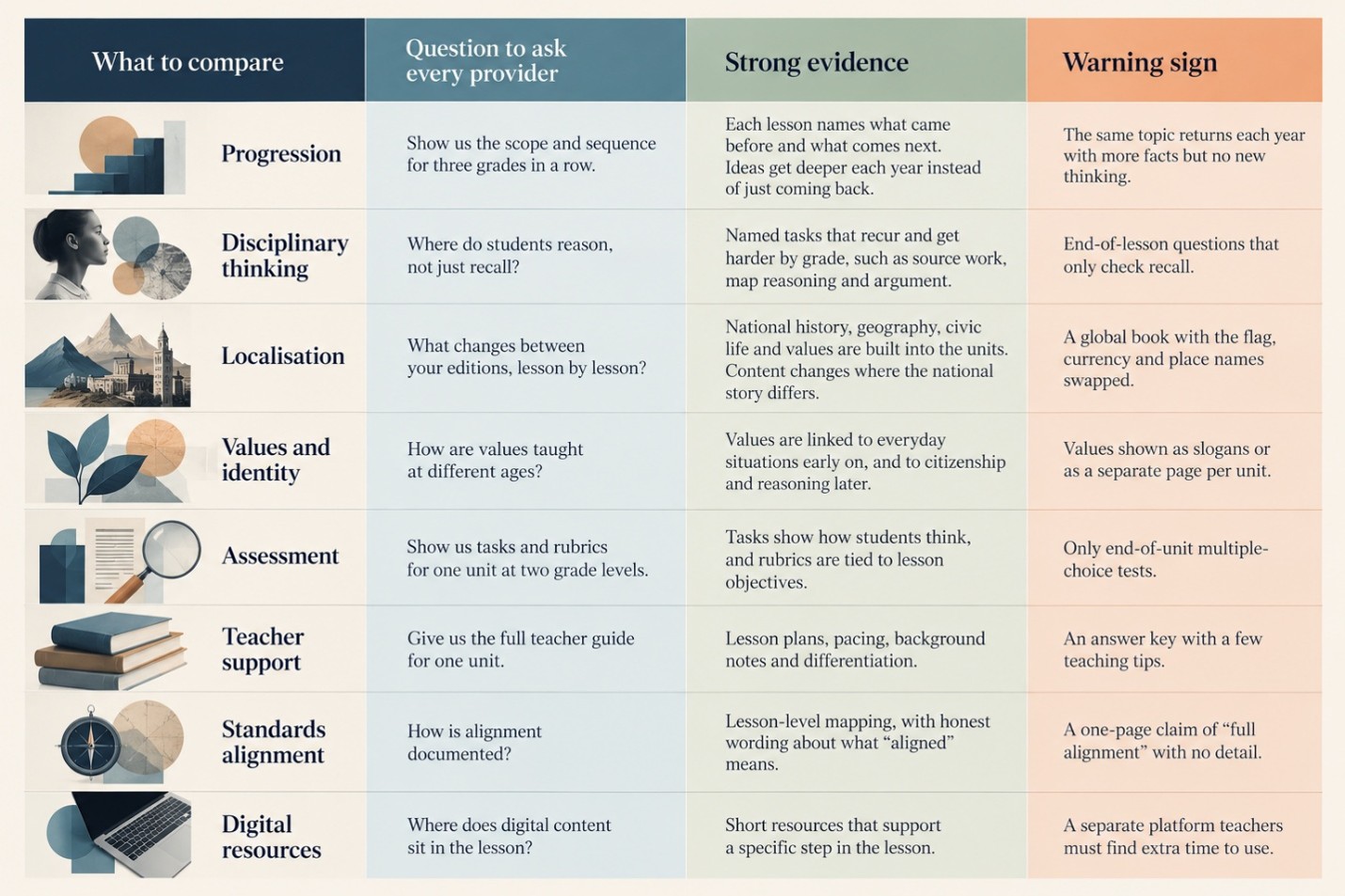
Two rows deserve extra weight in our schools.
Localisation. Every provider will say its content is local. The test is to ask for the same lesson in two editions and put them side by side. If only the names and pictures change, the curriculum is a global book with local decoration. Real localisation changes the national story, the heroes, the landscape students study, and how the national vision connects to what they learn about the economy and citizenship.
Teacher support. Many social studies teachers come from other education systems. They did not grow up with the national history, geography or institutions they are now asked to teach. Many students also study Social Studies in English as a second language. In this setting, a teacher guide with background knowledge, key vocabulary and clear lesson steps is not a luxury. It is what makes the curriculum teachable at all. For more on judging this, see [Blog 52 | What a Social Studies Teacher Needs Beyond the Textbook | Linked text: “evaluating social studies teacher support”].
Digital resources are easy to over-count. A provider with hundreds of videos is not automatically better than one with fewer videos placed exactly where a lesson needs them. The questions to ask are covered in [Blog 22 | Does a Lesson Video Deepen Social Studies Thinking? | Linked text: “evaluating social studies digital resources”].
How do you run the comparison fairly?
- Compare the same topic. Ask every provider for its lesson on the same theme at the same grade, such as community rules, the country’s regions or early trade. Differences in depth show up quickly.
- Use one scoring sheet. Every reviewer scores the same rows on the same scale and writes down the evidence behind each score.
- Include a teacher who will teach it. Ask them to plan one lesson from each provider’s guide, and time how long it takes.
- Set the weighting before scoring. Decide which rows matter most to your school before anyone sees the books. That way the weighting cannot be bent to fit a favourite.
Here is a useful test for any committee:
If you covered the provider names on every sample, could you still tell the curricula apart by what students are asked to do with knowledge?
If you could not, the comparison so far has been about design and packaging, not learning.
Price and service belong in the decision, but at the end. A curriculum that costs less but needs a year of teacher workarounds is not really cheaper.