

A Grade 8 lesson on climate change isn’t working. Students confuse weather with climate. They can’t read a climate graph. When the teacher mentions “average temperature over thirty years”, they look lost.
The usual explanations are time, motivation or weak students. The actual cause is often simpler. The idea the lesson depends on was never taught. Or it was taught once, three years earlier, in a lesson nobody linked to this one.
Why prerequisites matter more than we admit
More than fifty years ago, the educational psychologist David Ausubel argued that the most important single factor in learning is what the learner already knows. Most teachers agree with this. Few curriculum documents are checked against it.
The research on coherence supports the point. Schmidt, Wang and McKnight compared national content standards and found that high-performing systems tended to sequence topics in a way that follows the logical structure of the discipline, with later ideas built on earlier ones. Their study covered mathematics and science, not social studies. Social studies is less strictly layered than mathematics, but it still has real dependencies. Chronology comes before causation. Map scale comes before comparing distances. Scarcity comes before trade.
Four kinds of prerequisite
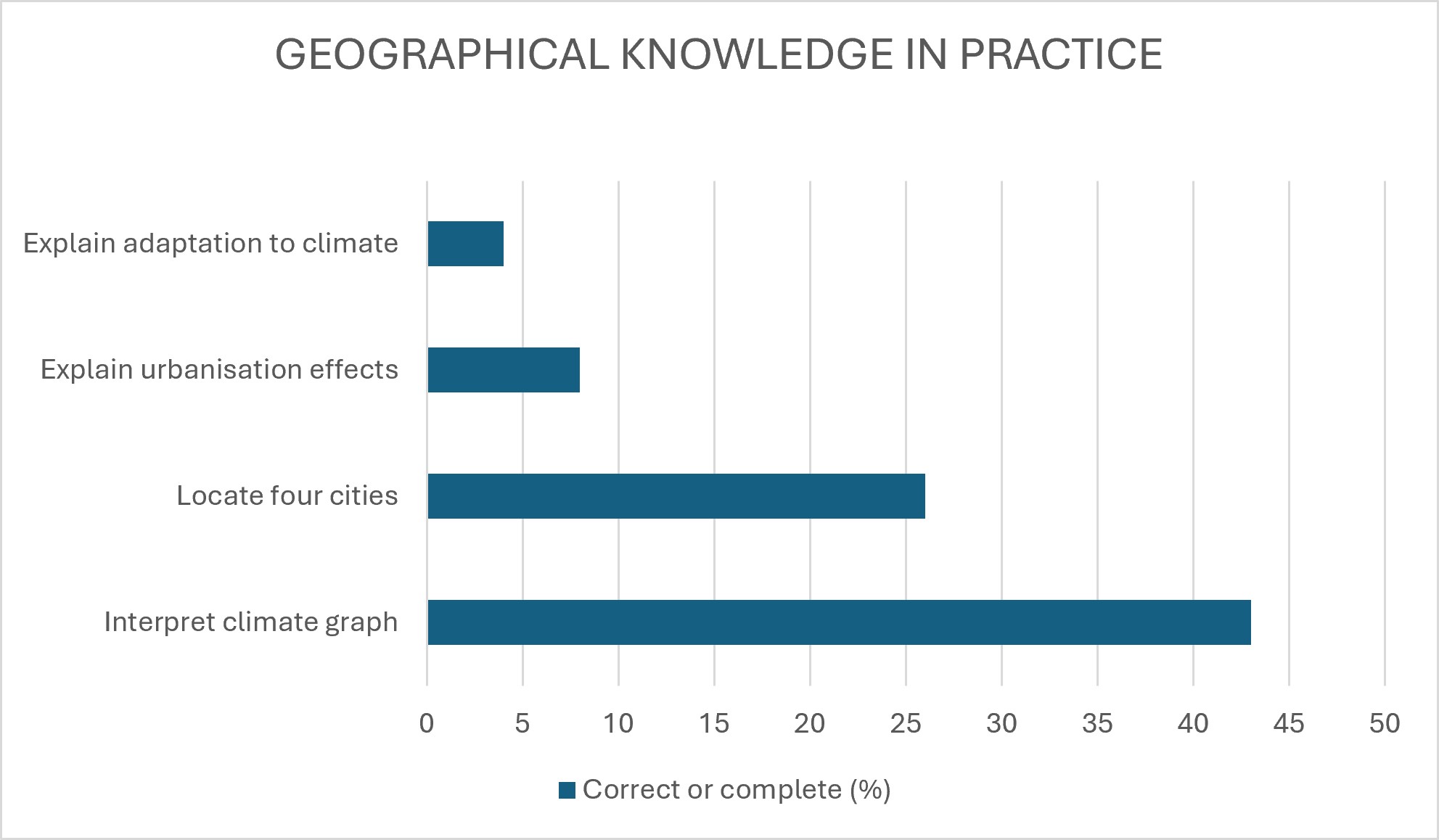
Source: NCES — NAEP Geography Sample Question,
Gaps are easier to find when you know what you’re looking for:
- Knowledge: facts or events the lesson assumes, such as knowing that trade caravans crossed deserts before studying why certain towns grew.
- Concept: an idea the lesson builds on, such as authority before comparing systems of government.
- Skill: a procedure students must be able to do, such as reading a scaled map or a line graph.
- Vocabulary: words the lesson uses without teaching them, such as resource, policy or primary source.
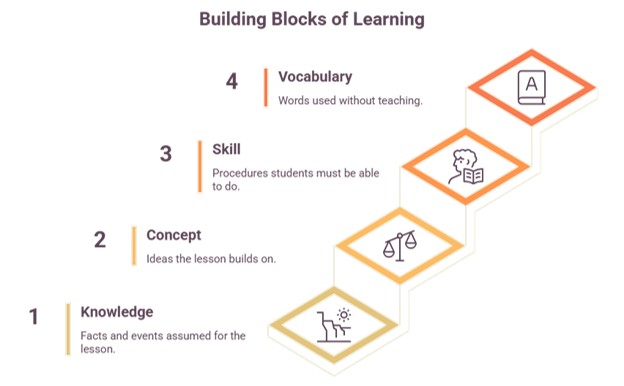
Skill and vocabulary gaps are the hardest to see because textbooks assume them without comment.
A simple backward audit
You don’t need to audit every lesson. Start with five to eight anchor lessons: the demanding tasks in the upper grades that the whole programme leads toward. For each one:
- List what a student must already know and be able to do.
- Search earlier grades for where each item was taught.
- Mark each item as found, partial, missing or wrong order.
- Fix the most-used gaps first.
| Anchor lesson (upper grade) | Hidden prerequisite | Type | Where it should appear | Typical finding |
| Climate change and adaptation | Weather vs. climate; reading climate graphs | Concept, skill | Middle primary geography | Often partial |
| National economy and natural resources | Scarcity; renewable vs. non-renewable | Concept | Early economics | Often taught, rarely revisited |
| Comparing systems of government | Rules, authority, rights | Concept | Early civics | Often found |
| Debate on dams and river ecosystems | River processes; stakeholders | Knowledge, concept | Physical geography, civics | Often missing |
| Rise of trading cities along ancient routes | Map direction and scale; oases and water sources | Skill, knowledge | Geography, one grade earlier | Often wrong order |
The last row shows one of the most common problems: cross-strand gaps. A history lesson needs a geography skill that the geography strand doesn’t teach until the following year. Neither strand team notices, because each one looks only at its own sequence. We look at this problem in [Blog 20 | Do Your History, Geography and Civics Strands Build on One Another? | Linked text: “social studies curriculum coherence”].
What an audit usually shows
Most audits turn up the same three things. Some prerequisites are taught once and never used again, so students have forgotten them by the time they’re needed. Skills such as graph reading are assumed but never explicitly taught in social studies. Some lessons come before the lessons that should support them, often because a topic was moved to fit a calendar.
An audit also makes standards mapping more useful. A map that shows where a standard is covered doesn’t show whether students were ready to meet it. We cover this in [Blog 50 | What Lesson-Level Standards Mapping Should Reveal in Social Studies | Linked text: “lesson-level standards mapping”]. For the bigger picture of how the path should develop, see social studies curriculum progression.
A question for curriculum teams: When a lesson fails, how often does your team check the grade below before looking at the teacher?
FAQs
Q: How long does a prerequisite audit take?
A: A focused audit of five to eight anchor lessons can usually be done by a small team in a few working sessions. It doesn’t need to cover every lesson to be useful.
Q: Who should be on the audit team?
A: At least one teacher from an upper grade and one from a lower grade, plus someone who knows all the strands. Cross-grade conversation is where most gaps come to light.
Q: What if a prerequisite is missing and we can’t change the textbook?
A: Add a short bridging activity before the anchor lesson and note it in the teacher guide or pacing plan. Then report the gap so it can be fixed properly at the next review.
Q: Should we audit before adopting a new programme?
A: Yes. Ask the provider for their scope and sequence, then trace two or three anchor lessons backward. It is one of the quickest ways to test whether a programme’s progression is real. See evaluating a social studies curriculum before adoption.