

Picture a hypothetical, but familiar, review week. The quality assurance folder is complete. Schemes of work are uploaded. The marking policy is signed. Every department has filed moderation minutes, and the termly data return reached the group office on time. The reviewer ticks every box.
Then someone opens a set of Grade 7 maths books. The same misunderstanding about fractions shows up in most of them in October. It shows up again in December, and again in the end-of-term paper. Every process was followed, and the learning problem survived all of them.
That gap is the subject of this article. An academic quality assurance framework built for compliance can prove that the right things happened. It rarely asks whether they made any difference to what students learned. A better framework asks both questions.
Compliance Proves Activity. Quality Assurance Should Test Consequence.
Compliance is not the enemy. Schools answer to boards, regulators, inspectors and parents, and they need to show that policies exist and are followed. A marking policy nobody uses is a real problem, and a compliance check will find it.
The trouble starts when compliance becomes the whole framework. Checks drift toward whatever is easiest to verify: whether a document exists, whether a meeting took place, whether a deadline was met. These are questions about activity. Quality assurance in schools, in the fuller sense, asks about consequence. Is our teaching and assessment producing the learning we say it does, and would we know if it wasn’t?
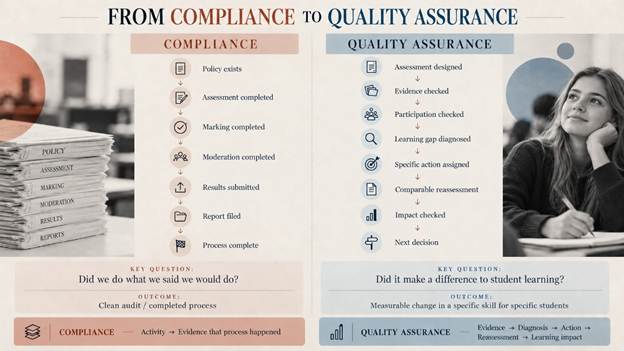
The difference shows up at every stage. A compliance-led framework is satisfied when papers were set, sat and marked on time. A quality-led framework also asks whether those papers measured the intended standards at the intended depth. In moderation, compliance checks that teachers agreed on marks, while quality assurance checks that they agreed on what actually counts as evidence of the skill. With data, compliance confirms that results were submitted. Quality assurance reads those results alongside who actually sat the test.
The sharpest difference comes after the report. Under compliance, the report is filed and presented, and the process is complete. Under quality assurance, a named action has to follow, and someone has to come back later to check whether it made a difference. That changes what success looks like. For a compliance framework, success is a clean audit. For a quality framework, success is a measurable change in a specific skill for specific students. It also changes the rhythm. Compliance tends to run as an annual or termly event, while quality assurance works as a continuous cycle in which each check leads to action and each action is checked again.
Three Places Where a Tick-Box Framework Stops Looking
Compliance frameworks tend to share the same blind spots. Each one is a place where a school can look healthy on paper while standing still.
The instrument itself. Moderation checks that marking is consistent. It rarely checks whether the paper deserved marking in the first place. If an end-of-term test is mostly recall questions, two teachers can agree on every mark while the school learns nothing about whether students can apply what they know. Quality assurance has to reach back into before it trusts any result. Shared understanding matters too: agreeing on what counts as evidence of learning is a quality question long before it becomes a marking question.
The students who are missing. A school average says nothing about who sat the test. If results rise in a term when a large share of the cohort was absent or excused, the “improvement” may simply reflect a different group of students. A framework that checks results without can end up rewarding the wrong thing.
What happened after the report. This is the biggest gap. Data is collected, analysed and presented. Everyone agrees that Grade 5 reading inference is weak. Then the next cycle begins and nobody comes back to ask whether anything was done, or whether it worked. The report was assured. The learning was not.
If every item on the audit is ticked and the same students are stuck on the same skills a year later, what exactly did the framework assure?
Designing the Framework Around Five Questions
A framework that goes beyond compliance does not need to be longer. It needs to follow evidence from the assessment to the classroom and back again. One practical way to structure it is five questions, asked in order.
| Leadership question | What you should expect to see | Warning sign |
| 1. Was the evidence sound? | A blueprint showing the standards, difficulty and cognitive demand the assessment covers | Papers written fresh each term with no record of what they measure |
| 2. Was the evidence complete? | Participation reported next to every result | Averages shown with no count of who sat |
| 3. Was the gap diagnosed? | Weakness located at competency or skill level, with a likely cause | “Reading is weak” presented as the finding |
| 4. Did a decision follow? | A named action with an owner, a student group and a date | Actions written as “continue to monitor” |
| 5. Did it work? | A comparable reassessment of the same skill in a labelled cycle | New tests each term that cannot be compared |
The third question deserves a closer look. A weak result is not yet a diagnosis. Students who never learned the content need different teaching from students who know it but cannot apply it. Both are different from a class that struggled because a few questions were pitched far too hard. When a framework stops at “results were low,” teachers are pushed toward reteaching everything, which is expensive in time and often the wrong response. This is where becomes part of quality assurance, not a separate activity.
The fifth question is where most frameworks go quiet. Checking whether an intervention worked means planning the reassessment at the same time as the intervention, with an instrument that is genuinely comparable. It also means looking at. A school with lower scores that is moving quickly may be better led than a high-scoring school that has not moved in two cycles.
In a School Group, Consistency Is Both the Goal and the Risk
For multi-campus groups, academic governance has an extra job. Leaders need to compare schools fairly, and that requires shared structures: the same subjects and competencies, the same assessment cycles, the same instrument when benchmarking. Without them, campus comparisons are mostly comparisons of different tests.
Central consistency can slide into central compliance, though. When the group office only collects returns, each campus learns to produce clean returns. A more useful arrangement sets the structure centrally and keeps judgement local. The group decides what is measured and when. The school and the teacher decide what the evidence means for their students. The group then checks whether those decisions led anywhere.
Would your framework notice if a school’s results rose only because fewer students sat the test? If the honest answer is “probably not,” the framework is checking the report rather than the learning.
Assurance Is a Promise About Learning
“Assurance” is a promise. A compliance framework promises that the school did what it said it would do. That matters, and those checks should stay. A quality framework makes a bigger promise: the school knows whether its teaching is working, and acts when it is not.
That shift does not need more paperwork. It needs existing checks to follow the evidence one step further each time: from the paper to what it measured, from the result to who sat it, from the gap to the plan, and from the plan to the reassessment that shows whether anything changed. For practical next steps on that last link, see.
Where Scholario Ascend Fits
Scholario Ascend is built around the same chain of evidence this article describes. Assessments are labelled to a cycle before anyone sits them, so later comparisons are like-for-like, and participation is shown beside performance. Question-bank items carry difficulty, DOK and standard codes, and AI-generated items are usable only after a person approves them. A weak result can be traced from subject to competency to skill, then into an intervention plan with owners and dates, followed by reassessment and growth on one shared scale. For school groups, that structure is set once across every campus. Deciding what the evidence means stays with educators.
Frequently Asked Questions
Q: What is an academic quality assurance framework?
A: It is a structured way for a school or school group to check the quality of its curriculum, teaching and assessment, and to act on what it finds. A strong framework covers both whether processes are followed and whether they improve learning.
Q: What is the difference between compliance and quality assurance in schools?
A: Compliance checks that required processes happened, such as moderation or data submission. Quality assurance asks whether those processes led to better learning, and what evidence shows it.
Q: Should schools drop their compliance checks?
A: No. Compliance is a useful floor. The problem is only when it becomes the ceiling. Keep the checks, and add questions about evidence quality, diagnosis, action and impact.
Q: How often should academic quality assurance happen?
A: It works best as a cycle tied to the assessment calendar, for example beginning, middle and end of year, rather than one annual review. Each check can then be followed by action and a comparable reassessment.
Q: How can a school group keep quality assurance consistent across campuses?
A: Share the structure centrally: subjects, competencies, assessment cycles and benchmark instruments. Keep interpretation and classroom decisions local, then review whether those decisions produced growth.
Q: What is a simple first step?
A: Take one recent assessment and follow it through the five questions above. The point where the trail stops is where your framework needs work.