
A four-year-old looks out of the classroom window at the road-sweeper and asks, “Is he a community helper?” The wall chart shows a doctor, a firefighter and a police officer. It has no road-sweeper. The honest answer is yes, and the chart has just shown its limits.
Most preschool curricula include community learning somewhere. The harder question is what it actually teaches. Does the unit help children recall a list of jobs, or does it help them see that a neighbourhood works because people depend on each other?
Why one week is not enough
Community learning often arrives as a themed week. Helpers on Monday, a video midweek, a dress-up day on Friday. Children enjoy it. Then the display comes down and nothing in the next unit builds on it.
For curriculum leaders, this is a design problem more than a teaching problem. If the same helpers appear at every level with slightly harder worksheets, the strand is repeating, not progressing.
What community learning means in a preschool curriculum
What is community learning in a preschool curriculum?
It is a planned strand in which children learn how the people, places and roles around them depend on one another. They learn through play, role-play, mapping, stories and local experiences. The content widens as they grow, from knowing who helps them to sharing responsibility.
The word that matters is strand. A strand has a direction. It can also connect to other areas: language through stories, early maths through map-building, and social-emotional learning through teamwork.
A progression that goes somewhere
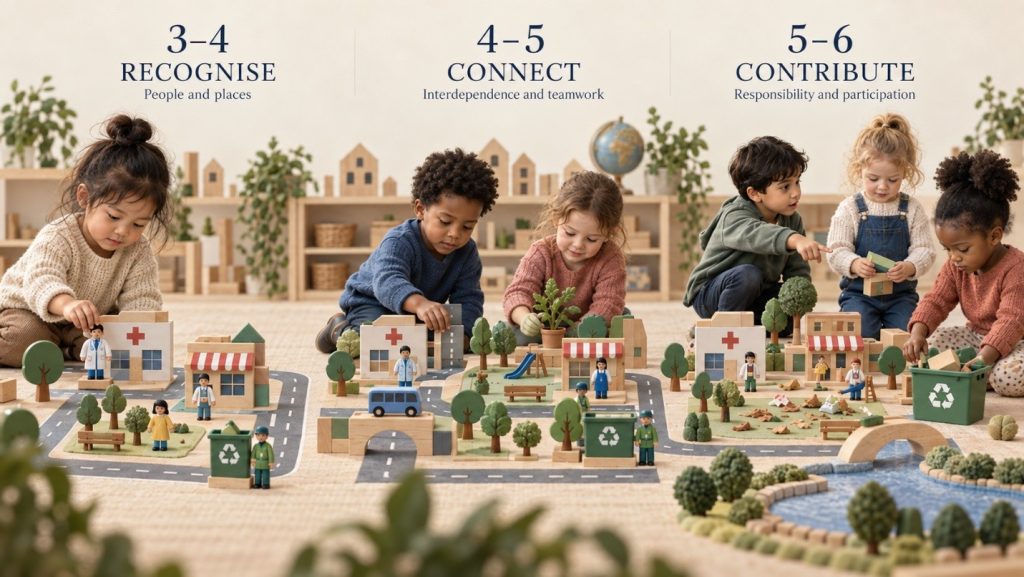
The focus column below follows KODEIT Pre-K’s Book 2, Exploring My World, at each level.
| Level (age) | Curriculum focus | What children might do | What teachers might notice |
| Level 1 (3–4) | Community helpers, safety, nature | Match helpers to places, role-play a clinic or shop, build a simple neighbourhood with blocks | Names a role, links a helper to a need, uses words like “helps” |
| Level 2 (4–5) | Roles in the community, teamwork, conservation | Share class jobs, sort places by purpose, care for a class plant together | Explains why roles depend on each other, shares tasks, offers ideas |
| Level 3 (5–6) | Leadership, problem-solving, global citizenship | Solve a shared problem, such as keeping the play area tidy; lead a small-group role-play | Proposes a solution, takes a turn leading, considers how others are affected |
By Level 3, the strand is about responsibility, which is where community learning meets Citizenship Progression.
How do we know a child has learned it?
A child who recites five helpers has shown recall. A child who builds a block neighbourhood and adds a bin lorry because “somebody has to take the rubbish away” has shown something closer to understanding.
Evidence of this kind appears in role-play, mapping, drawings and conversation, not on a worksheet. So it helps to plan for evidence of learning through play How to Collect Evidence of Learning Through Play. It also helps to place those observations inside a wider Early Years Assessment Framework.
If the assessment only asks children to name helpers, who will notice the bin lorry?
What recent research suggests
US research supports community connection but warns against treating it as one thing. A 2024 study by Pilarz, Lin and Premo used data from a public pre-k program in a mid-sized Midwestern city. It tested whether family engagement practices, including helping families reach community services, were linked to attendance and early skills. It found limited evidence of average links. The clearest result was that more frequent teacher communication with families went with lower chronic absence (about 18% lower odds per standard-deviation increase), and results differed by child, family and program. The study covers one district and is correlational. NAEYC’s 2020 position statement takes a wider view. It treats social and cultural context as the framework for all learning, names family partnerships and community connections as one of six areas of practice, and notes that early education settings are often a child’s first community outside home. The practical reading is that “community engagement” is not one action. Each connection needs a clear purpose. (Family engagement)
Where KODEIT Fits: Following One Community Lesson From Page to Home
Take one Level 1 lesson, Community Helpers.
- The page. KODEIT’s lesson-level flow starts with pictures, icons or real-world scenes, so children recognise the idea before it is taught. A picture story then builds the concept. The source example is a doctor treating a patient.
- The play. Children move into matching or sorting, then role-play and movement. The Level 1 NGSS-enriched mapping suggests building a 3D neighbourhood from blocks or printed icons and discussing what each place is for.
- The teacher. Teacher Books follow the PLAY framework. They add learning objectives, key vocabulary, differentiation tips, observation tools and home connection ideas. The Yield stage includes a real-world connection and a home-school suggestion.
- The record. The programme includes 270+ formative and summative evaluations, covering observations, portfolio tasks and milestone tracking. It also includes 90+ rubrics for tracking developmental progress.
- The progression. Book 2 returns at Levels 2 and 3 with a widening focus, from roles and teamwork to leadership and responsibility. KODEIT describes its approach as globally aligned and locally relevant. How far a school localises the examples is still a curriculum-team decision.
The more useful question may not be “Did we cover community helpers?” but “Can a child explain who they depend on, and what they can do for others?” A curriculum that can answer that has moved from a theme to a strand.
Frequently Asked Questions
Q: How is community learning different from a community helpers theme?
A: A helpers theme is one unit. Community learning is a strand that returns at each level with more depth: who helps us, how roles depend on each other, and how children take responsibility.
Q: When should community learning start?
A: Early. KODEIT Pre-K starts at Level 1 (ages 3–4) with helpers, safety and nature. Safety deserves its own careful treatment, which is covered in community safety themes [Community Blog 21 | Community Safety Themes in Preschool Programmes | Linked text: “community safety themes”].
Q: Do children need field trips?
A: Not always. Local walks help, but role-play, block maps, stories and visitors can carry much of the learning. Families can add local knowledge too, which connects to family identity and belonging [Community Blog 19 | Family Identity and Belonging in Early Years Curriculum | Linked text: “family identity and belonging”].
Q: How can teachers assess community learning without testing?
A: Observe role-play and mapping, listen to children’s explanations and keep a few drawings. Record one or two clear behaviours tied to the objective, not everything.
Q: Where does real-world learning fit?
A: Community is one context for it. The wider design question is covered in real-world application [Community Blog 20 | Real World Application in Preschool Curriculum Design | Linked text: “real-world application”].