
In many primary schools, “needs and wants” is taught in Grade 1, again in Grade 2 and again in Grade 3. Then, around Grade 7, students meet global trade, resource economies and international organisations with almost nothing in between. The first idea gets too much time, and the bridge to the big ideas gets too little.
A strong economics curriculum progression works differently. It keeps a small number of core ideas steady and lets the scale and complexity grow around them.
What idea holds an economics progression together?
Choice. People, families, businesses and countries never have enough of everything, so they choose, and every choice gives something up. Trade grows out of this, because people exchange what they have for what they need. Interdependence grows out of trade.
If choice, exchange and interdependence run through every grade, a Grade 8 lesson on global trade is not new content. It is the Grade 1 pocket-money decision, played out between countries. The early-grade side of this is covered in [Blog 42 | Teaching Economic Thinking Through Choices Children Can Explain | Linked text: “economics education in primary school”].
How should the scale grow from grade to grade?
| Grade band | Core economic idea | Everyday anchor | What students can explain |
| Grades 1–2 | Needs and wants; money; saving, spending and giving | Choosing between two things at the shop; a family giving to charity | What they chose and what they gave up |
| Grades 3–4 | How goods move; local trade; simple supply and demand | The local market; why date prices change with the season | Why prices go up or down |
| Grades 5–6 | Historical trade routes and early trade networks; how resources shape economies | Incense and spice routes, caravan towns and ports | How geography shaped who traded what |
| Grades 7–8 | Natural resources and national economies; diversification; the modern global economy | A resource-rich country planning for a future beyond one resource | Trade-offs and interdependence between nations |
This is also where economics needs geography and history. Trade routes are a history topic, a geography topic and an economics topic at the same time. Teaching them in separate years or separate books wastes a natural connection. The wider case for this is made in [Blog 18 | From Community to Global Systems: What Should Progress in Social Studies? | Linked text: “social studies curriculum progression”].
What makes economics feel real to our students?
Three things work especially well.
Charity and Zakat. Giving is part of everyday life for many families. Taught well, Zakat and charity introduce young students to a real economic idea: wealth moves through a community by obligation and choice, not only by buying and selling. That gives “saving and spending” a third partner, which is sharing.
Trade history. For centuries this land sat on trade routes linking continents. Students can see that exchange and interdependence are not foreign ideas but part of their own past.
A live economic story. Students grow up in economies that are actively planning to depend less on a single resource.
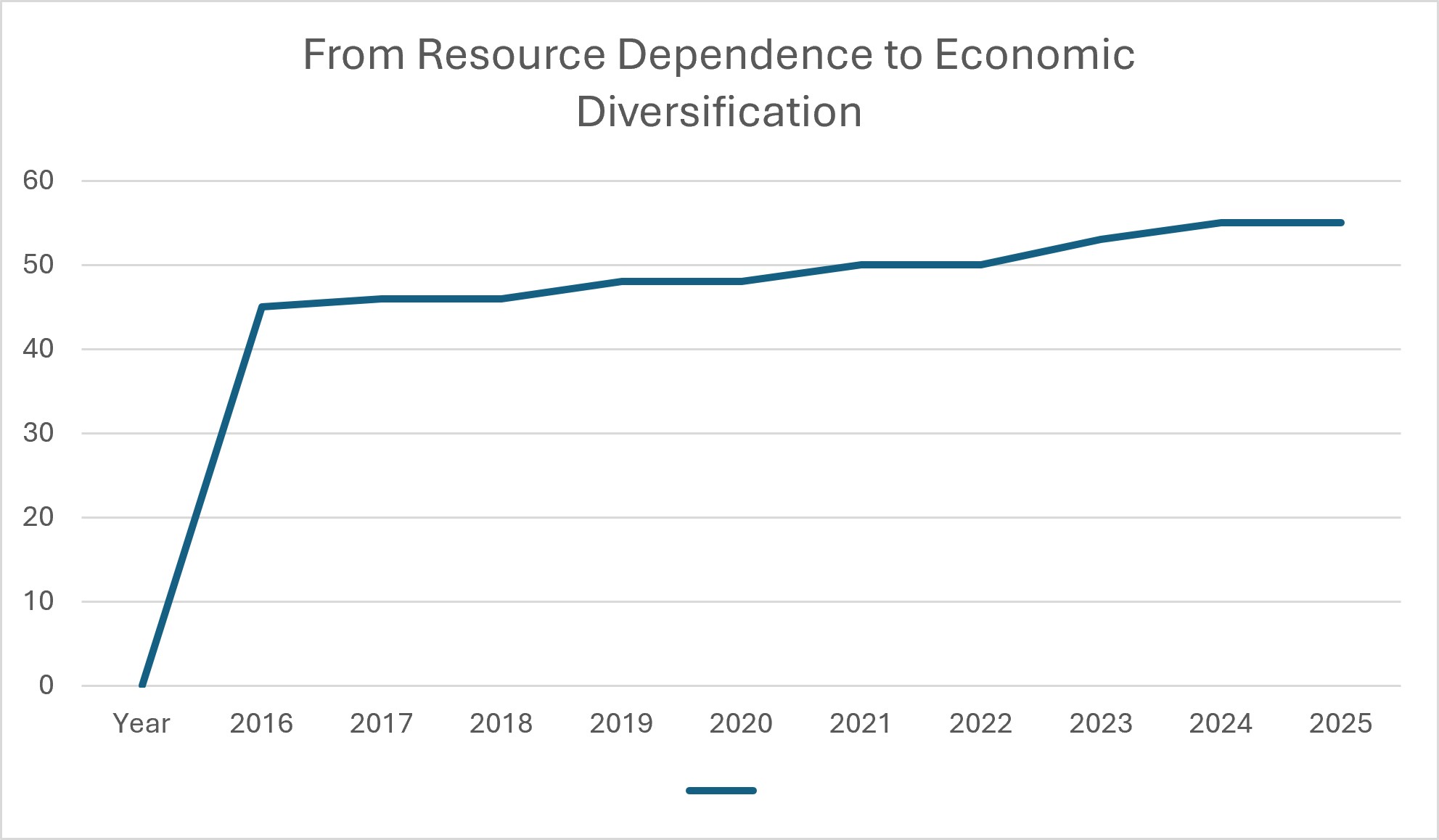
Source: Saudi Arabia’s non-oil activities represented 45% of real GDP in 2016 and 55% in 2025. The historical series below is reproduced from the 2025 Vision 2030 annual reporting. Argaam.
National vision plans give upper grades a real case of choice and trade-off: what to invest in, what to give up, and why. Economies differ from country to country, so the curriculum should use students’ own national context accurately instead of one general picture.
Saudi Arabia provides a real-world example of how national economic choices shape the future of an economy. Non-oil activities increased from 45% of real GDP in 2016 to 55% in 2025, a rise of 10 percentage points. The change illustrates the growing contribution of economic activities beyond oil production.
For students, this creates an opportunity to explore economic diversification through questions about investment, resource allocation and trade-offs. Why might a country invest in manufacturing, tourism, technology and logistics? How do these decisions influence employment, international trade and long-term economic opportunities? The same principle introduced through a Grade 1 spending decision now operates at a national scale: resources are limited, choices must be made, and each decision carries an opportunity cost.
Can your Grade 8 students connect a Grade 1 pocket-money choice to the choices a country makes about its resources? If not, the curriculum has taught economic topics, but not economic thinking.
What should curriculum leaders check?
Ask whether each grade adds a new economic idea or only a new example. Check that there is a clear bridge from personal choice to markets, and from markets to national and global systems. Look for projects that ask students to make and justify economic decisions. A project where students design a sustainable city with a fixed budget brings economics, civics and geography into one task. That idea is developed further in [Blog 48 | Teaching Sustainability Through Geography, Economics and Civic Choices | Linked text: “sustainability in the social studies curriculum”].