
Most social studies programmes follow a familiar path. Children start with themselves and their family, move to the school and neighbourhood, then the nation, and finally the world. This structure is usually called the expanding horizons model. It is one of the most common designs in primary social studies.
It lasts because it makes sense. Young children learn best from what they can see and touch. Starting local builds identity and belonging before students meet distant places.
But one question gets asked too rarely:
when the map gets bigger, does the thinking get harder?
A bigger scale isn’t the same as a harder task
Picture two lessons. In Grade 1, students list the people who help their community. In Grade 5, students list the parts of national government. The scale has grown. The thinking task hasn’t changed: identify and list.
This is the weakness of a progression built only on scale. Each year adds new, larger content, but students do the same mental work with it. Over time the curriculum gets heavier without getting deeper.
The OECD report Curriculum Overload: A Way Forward describes this pattern in many education systems. Content is added over time, often for good reasons, until the curriculum becomes crowded and depth suffers. The report separates several forms of overload, including content overload and curriculum imbalance. When each new scale brings a new set of topics, social studies is especially exposed to this.
Five things that should progress, not just one
Scale is only one part of progress. In a strong K-12 social studies curriculum, four other things grow along with it.
The first is complexity. Young students work with one cause and one effect, such as “it rained, so the street flooded.” In the middle grades, they learn that several causes can work together. By the upper grades, they study whole systems where every choice has a trade-off and one change sets off others.
The second is evidence. Early learners use pictures, stories and what they can see around them. Middle-grade students move on to maps, simple data and a small set of sources. Older students work with sources that disagree, real data sets and future projections, and they have to decide which evidence to trust.
The third is perspective. A young child starts with “How would I feel?” A middle-grade student asks “How did people at that time see it?” An upper-grade student asks “Why do different groups disagree, and who gains from each outcome?”
The fourth is judgement. Early grades focus on right and wrong actions. The middle grades bring in fair and unfair choices. The upper grades ask students to weigh two good goals against each other, which is what real policy decisions involve.
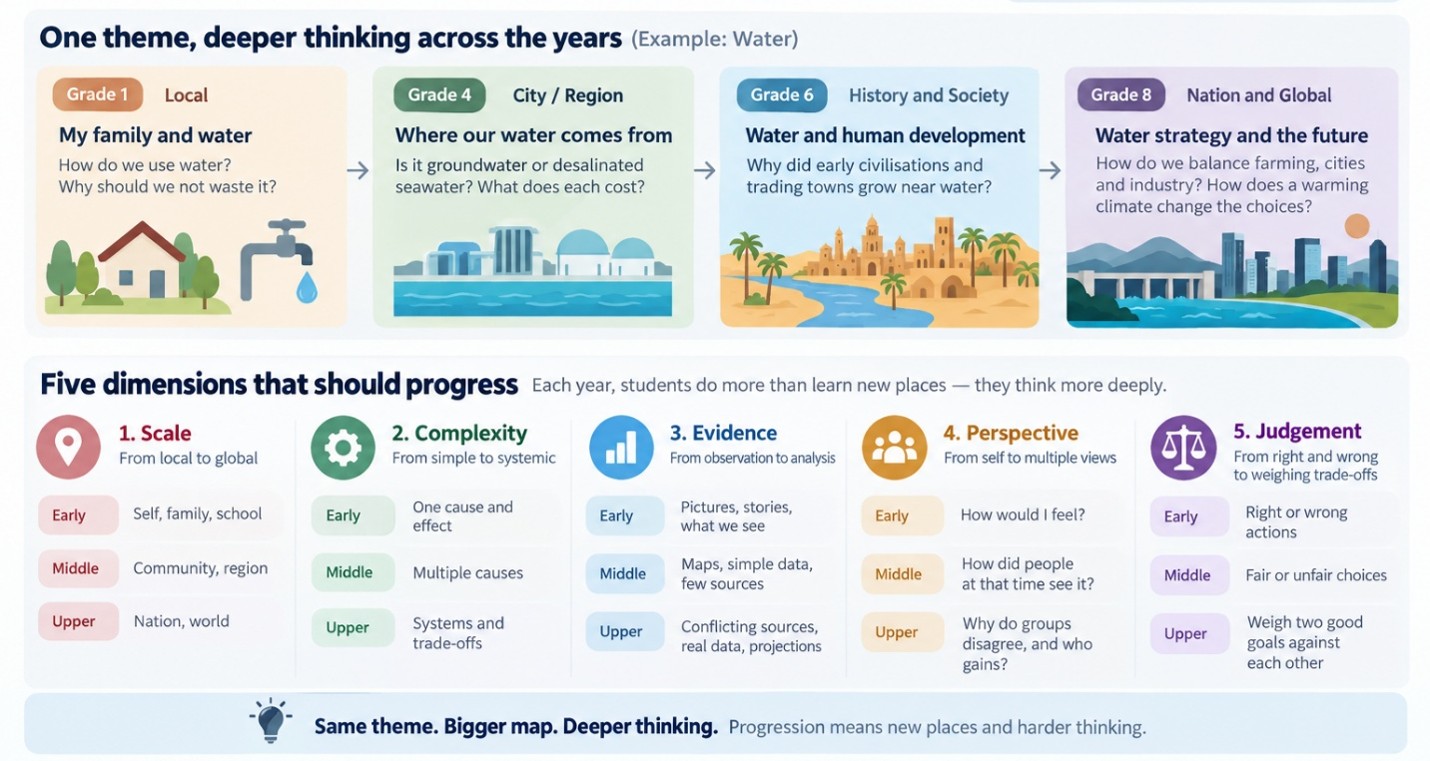
Curriculum teams can use these five dimensions to check any unit. If a Grade 7 unit is “global” in scale but still asks students to think the way they did in Grade 2, the scale has grown but the learning has not.
One theme, eight years
Take water, which matters a great deal in arid regions.
In Grade 1, students talk about how their family uses water and why they shouldn’t waste it. In Grade 4, they find out where their city’s water comes from, which might be groundwater or desalinated seawater, and what each costs. In Grade 6, they study why early civilisations and trading towns grew near reliable water. In Grade 8, they look at national water strategy: the trade-offs between farming, cities and industry, and how a warming climate changes the choices.
The theme stays the same. The thinking grows each time. That is progression in its fullest sense, and it is the idea behind [Blog 47 | Building a K-12 Social Studies Curriculum That Does More Than Cover Content | Linked text: “social studies curriculum design framework”].
The same logic applies within each strand. Civics should move from following rules to understanding why rules exist and who makes them. We follow this in citizenship education curriculum progression. In geography, students should move from naming places to explaining them, as mapped in [Blog 44 | Mapping Geographical Thinking From Primary to Secondary: A Progression Model | Linked text: “geography curriculum progression K-12”].
Don’t treat “local” as “simple”
The expanding horizons model has a quiet weakness. It can imply that local topics are easy and global topics are hard. That isn’t true. A debate about how a neighbourhood should use shared land can be as demanding as any question about the United Nations. And children today see global events on screens long before a syllabus says they are “ready” for the world.
A better approach is to come back to the local at every stage, with more demanding questions each time. Upper-grade students can study their own city’s growth using census data and planning documents. Local then stays a place for serious thinking rather than a stage students leave behind.
A question for curriculum teams: