
Open almost any social studies programme and you’ll find History, Geography and Civics sitting neatly in the same grade. The timetable looks integrated. The contents page looks balanced.
Now try a simple test.
Remove the geography lessons from Grade 6. Do the history lessons still make sense?
If they do, the two strands are neighbours, not partners. They share a grade but not a purpose.
Being next to each other isn’t coherence
Curriculum coherence is often confused with coverage. A programme can include every required topic and still leave students with separate pieces of knowledge that never connect.
The OECD report What Students Learn Matters lists coherence and interdisciplinarity among the principles for designing a curriculum. It treats coherence as more than including topics: it is about how ideas are ordered and linked so learning builds over time. For social studies, this means the strands should strengthen each other, not simply run in parallel.
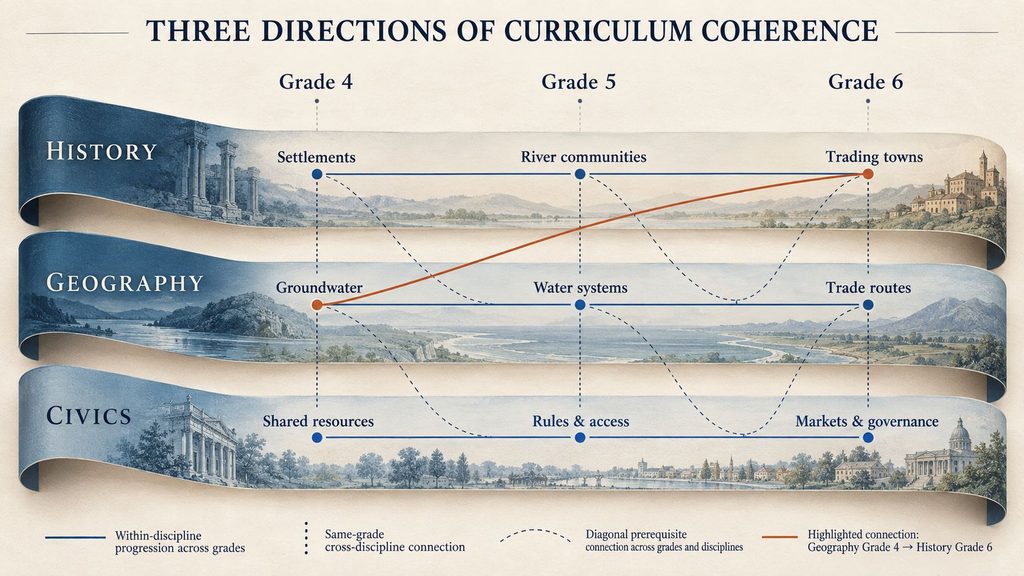
Coherence runs in three directions
Vertical – within one strand, from grade to grade. Grade 6 history builds on Grade 5 history.
Horizontal – across strands in the same grade. A unit on ancient trade routes in history is taught alongside human-environment interaction in geography, so students see why the routes followed oases and coastlines.
Diagonal – across strands and across grades. A Grade 4 geography lesson on groundwater prepares for a Grade 6 history lesson on why trading towns grew where they did. Diagonal links are the most valuable and the least planned, because no single strand team owns them.
A programme can be strong vertically and weak horizontally. That is common when separate specialist teams write each strand. It can also look integrated on the page while having no diagonal links at all.
Integration shouldn’t erase the disciplines
There’s an opposite risk too. In the rush to integrate, some programmes blend everything into general “themes” where no discipline’s thinking is taught properly. A historian judges sources and change over time. A geographer reasons about space, place and process. A civics student reasons about rights, rules and fairness. These are different kinds of thinking.
Good coherence keeps them distinct and makes them meet. A unit on a historic port city might ask a geographical question (why here?), a historical question (how did it change, and what sources show that?) and a civic question (who made the decisions, and who benefited?). We develop this in interdisciplinary social studies curriculum.
A quick coherence check
| Question to ask | Weak sign | Strong sign |
| Do strands in the same grade share a question? | Topics sit side by side, unrelated | A shared compelling question links two or more strands |
| Does one strand use what another taught? | Each strand reteaches its own basics | History uses map skills taught in geography |
| Are diagonal links planned? | Links happen by accident | The scope and sequence names cross-strand prerequisites |
| Does each discipline keep its own thinking? | “Themes” with no clear type of reasoning | Each lesson names the thinking it develops |
| Can teachers see the connections? | Links exist only in the writers’ heads | The teacher guide points them out lesson by lesson |
If most answers land in the weak column, the programme may be covering the right content but not building understanding. A backward prerequisite audit, described in missing prerequisites in a social studies sequence, is often the fastest way to find where the strands have drifted apart. For the vertical dimension, see social studies curriculum progression.
A question for curriculum teams:
If each strand team wrote its sequence without ever seeing the others’, how different would your programme look from the one you have now?
FAQs
Q: Should history, geography and civics always be taught together?
A: No. Some lessons need focused time in one discipline. Coherence means the strands are planned to connect at the right points, not that every lesson mixes them.
Q: What is the difference between horizontal integration and coherence?
A: Horizontal integration is one part of coherence: links across strands in the same grade. Full coherence also includes vertical progression within each strand and diagonal links across grades.
Q: How can a school check coherence without rewriting the curriculum?
A: Use the table above on one grade at a time. Then check two or three upper-grade lessons for prerequisites that were supposed to come from another strand.
Q: Where does coherence fit when evaluating a new programme?
A: It should be a core criterion. Ask the provider to show, lesson by lesson, where strands connect. See evaluating a social studies curriculum before adoption.