

The badge is small. A picture, a star and a name: ICT Star. A young student earns it for finishing a step-by-step drawing activity in a digital paint program. The description says she has shown creativity and an understanding of the brush, fill and magic tools.
The badge is true. She did finish. What it can’t say is this: a week later, with no steps on the screen, could she open the same tool and draw something of her own?
That gap, between finishing and knowing, is where a lot of computer science reporting quietly sits.
Why schools end up counting activity
Nobody sets out to measure the wrong thing. Platforms count what they can count: logins, minutes, activities completed, quizzes passed. These numbers are quick to collect and easy to put in a report. Parents and boards ask for progress, and a completion rate looks like progress. And a teacher with twenty-eight students and one lesson can’t sit beside every child while they code.
So the report fills up with activity. Activity isn’t worthless. A student who did nothing learned nothing. But activity only proves one thing: the student was there when the work happened.
The student who finished everything
Many school leaders have met this student, even if no report ever showed her. She completed every unit. Her projects ran. Her quiz scores were fine. Then, the next year, a teacher hands her a blank file and a simple problem. She doesn’t know where to start.
Nobody let her down on purpose. Every step she took was guided, and every guide worked. But the guides were never taken away. So nobody, including her, ever found out what she could do alone.
This matters more now than it did five years ago. When an AI tool can write working code in seconds, a program that runs proves even less about who understood it. It is worth noticing that the new 2026 CSTA PK–12 Computer Science Standards, published in the US, shift from mainly writing code towards also reading, evaluating, modifying and debugging programs. Those are exactly the skills a finished file can’t show.
So the usual question, “How much of the course have our students completed?”, gets an answer that is accurate and not very useful. A sharper question is:
“What could our students do next week, without the instructions in front of them?”
Activity evidence vs learning evidence
| What schools often report | What it actually proves | Stronger evidence of learning | What that proves |
| Percentage of activities completed | The student moved through the steps | Solves a similar problem with the steps removed | They can do it alone |
| The project runs | The final file works | Changes the project to meet a new requirement | They understand how it works, not just that it works |
| Quiz score | They picked the right answer that day | Finds and fixes a bug they didn’t write | They can read code and reason about it |
| Badge or certificate | The activity was finished | Explains why they chose one approach over another | They made decisions, not just followed them |
| Time spent on the platform | They were logged in | Uses the same skill months later in a new unit | The learning lasted |
Four moves that turn activity into evidence
You don’t need a new assessment system to get the right-hand column. You need four small moves, built into lessons that already exist.
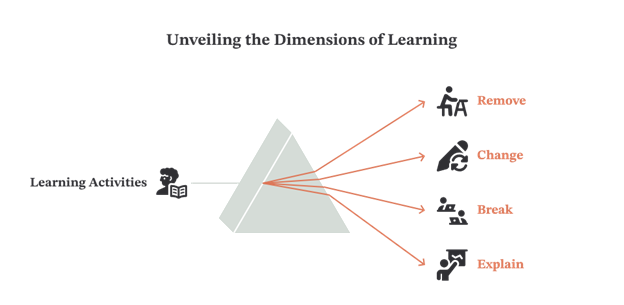
Each move takes minutes, not a new unit. And each one produces something a teacher can see, hear or grade.
A test to run this term: the blank-file check
Pick a unit your students finished recently. Choose five students with high completion. Give each one a small task that is one step different from the unit. No worked steps. Fifteen minutes. Ask each student to talk you through one decision they made.
Don’t grade it. Just note who could start, who could finish, and who could explain.
Then put your notes next to the completion report for the same five students. If they tell the same story, your reporting is sound. If they don’t, one afternoon has told you more than the dashboard did all term.
How it builds, in both directions
When a school counts activity, courses are designed to be finished. Students learn that the goal is the green tick. Teachers feel pressure to keep everyone moving. The next report looks even better, and says even less.
When a school looks for evidence, lessons build in moments where the support comes off. Students learn that being stuck is part of the work. Teachers spot who needs help in October, not June. The report shows smaller numbers, and more honest ones.
Most of us would choose the second kind of report. Far fewer of us have asked for it.
So here is a question to take into your next review. If your computer science report could only include what students did without help, which number in it would change the most?
Where KODEIT fits
First, an honest note. The ICT Star badge at the top of this article comes from KODEIT’s own platform. Like every completion badge, it proves completion. We don’t claim more for it.
What we build around it is room for stronger evidence. Rubrics grade understanding, with a top band that asks for more than correct labels. When a student submits code, the teacher sees a suggested grade, a written rationale, and indicators for plagiarism risk and likely AI generation. These are a reason to talk to the student, not a verdict. And Student Queries keeps each question a student asks, with the teacher’s reply, so teachers can see how a student is thinking, not only what they handed in.
None of this replaces the blank-file check. Run it on your current programme first, whoever made it.
Frequently Asked Questions
What counts as evidence of learning in computer science?
Evidence of learning shows what a student can do on their own, not just what they completed. Good examples are solving a new problem without steps, changing a working project, fixing a bug, or explaining a choice they made.
Why isn’t course completion enough?
Completion shows a student worked through the activities. It doesn’t show whether they could repeat the skill without guidance, or use it in a new situation. It is a useful number, but it measures activity, not understanding.
How does AI change assessment in computer science?
AI tools can produce working code quickly, so a finished program says less about who understood it. Tasks that ask students to explain, modify or debug code become more important. AI-detection indicators can help a teacher decide what to look at, but they shouldn’t be treated as proof on their own.
What does evidence of learning look like for younger students?
It is often spoken or hands-on. A young student might repeat a task with the instruction cards turned over, sort items and give a reason, or tell the teacher why a sequence of blocks works. Short conversations can be strong evidence at this age.
How can schools report computer science progress to parents in a meaningful way?
Share one small piece of student work alongside a plain statement of what the student can now do independently. For example: “Can build a simple game loop without a worked example.” This tells parents far more than a completion percentage.