

Ask a school to show you evidence that its students create technology, and you will usually be handed a slide deck.
It will be a good slide deck. Fourteen slides, consistent typography, a lightbulb on slide six. The teacher planned the lesson properly and the student worked hard on it, and neither of those things is in question here.
But it was made in an application someone else built, using a template someone else designed, to answer a brief the teacher specified, following steps demonstrated on the board. Four sets of decisions were made before the student sat down. What she did was assembly.
That is not a criticism of the lesson. Assembly is a legitimate stage and a necessary one. The problem is that we started calling it creation, and once a word covers everything, it stops describing anything including the thing you were trying to evidence when the inspector, the governors or the parents asked.
Why the line blurred
Tools got good. That is genuinely the whole cause, and it is nobody’s fault.
Twenty years ago, making almost anything digital meant understanding some of the machinery. Now the machinery sits behind interfaces designed to make production effortless. That is excellent software design and terrible curriculum evidence. A student can produce a polished artefact in four minutes without making a single decision about how it works.
The feeling of creating has come apart from the act of creating. So a school looking at a corridor display of impressive student output has no reliable way to tell which side of the line any of it came from and the display looks the same either way, which is exactly why nobody has caught it.
One question tells you which rung you are on
The useful test is not what did the student make? It is who made the decisions?
Run any activity through that question and it lands somewhere on a ladder.
| Rung | What it looks like | Who made the decisions |
| 1. Operate | Using a tool to produce an output | The tool did |
| 2. Follow | Completing a tutorial or worked example correctly | The instructions did |
| 3. Assemble | Filling a structure someone else designed | The template did |
| 4. Adapt | Changing something and judging whether it worked | The student did, within a set brief |
| 5. Author | Deciding what to build, how to build it, and whether it is any good | The student did, including the brief |
Nothing on the lower rungs is wasted. Students have to operate tools fluently and follow instructions successfully before they can do anything else, and a class that skips rungs one and two produces confident nonsense. The failure is not spending time down there. The failure is a whole school career spent down there while the prospectus describes rung five.
Four activities that get misread
These are all worthwhile lessons. They are just not where schools usually file them.
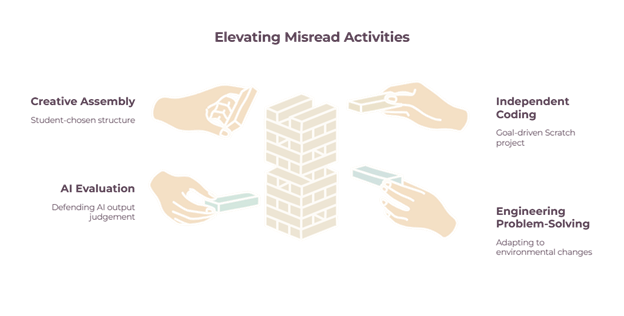
The pattern is consistent, and it is the cheapest finding in this article: moving up a rung almost never requires a better tool. It requires removing something a step, a template, a specification so that a decision falls back to the student.
“Are our students creating?” is the wrong question. It has no answer, because the word now covers everything from rung one to rung five. Ask this in your next scheme of work review instead: across a full term, how many decisions does a student in our programme actually get to make and who currently makes the rest?
That one is countable. Someone can go away and come back with a number by Friday.
What the European frameworks are actually asking for
It is worth noticing that the two reference points most European schools work from are pointing at different rungs, and conflating them is part of how this happened.
DigComp 2.2, the European Digital Competence Framework for Citizens published by the Commission’s Joint Research Centre in 2022, sets out 21 competences across five areas information and data literacy, communication and collaboration, digital content creation, safety, and problem solving. It is a citizenship framework. It describes the floor every young person in Europe should reach, and “digital content creation” there means something closer to rungs two and three than to rung five.
The Informatics Reference Framework for School, published in February 2022 by the Informatics for All coalition, is doing a different job: it treats informatics as a discipline in general education and is built on a set of core concepts intended to help curriculum designers review their focus and approach to the subject. It sets out what students are expected to be competent in by the end of upper secondary, at age 18, and it is deliberately high-level, leaving specific curricula to be defined country by country.
A school can meet the citizenship floor completely and still run a programme that lives entirely on rungs one to three. Both frameworks are right. They are simply not interchangeable, and a scheme of work mapped only to the first will look fully aligned while producing no evidence of the second.
Generative AI sharpens the line rather than erasing it
The common worry is that AI makes the whole distinction pointless. If a model writes working code, why teach a fifteen-year-old to write it?
Look at what AI actually does to the ladder.
It is extraordinarily good at the middle. Following specified steps, assembling components, adapting an existing pattern that work now takes seconds. It is much weaker at the top, where someone has to decide what is worth building and judge whether the result is any good. And at the bottom, it makes operating a tool easier than it has ever been, which is precisely why operating a tool is now worth almost nothing as evidence of capability.
A student who can only operate is now indistinguishable from someone with no education in the subject at all, because the tool does the work either way.
There is a regulatory version of this arriving in the same period, which makes it harder to defer. Under the EU AI Act, the duty on providers and deployers of AI systems relating to staff AI literacy has applied since 2 February 2025 schools using AI tools are deployers. Wherever that duty settles in practice, the direction is clear enough: a school will increasingly be expected to be able to say what its students and staff understand about these systems, not merely which ones it has a license for.
The distinction between consuming and creating has not gone soft. It has become the whole point.
The loop, in both directions
Forward: students get decisions to make, so their work carries reasoning, so the school can evidence capability rather than output, so leaders trust the subject with time and choose tools on whether they leave decisions open.
Backward, and this is the version already running in most schools: creation is hard to evidence, so the school evidences output instead, so it buys tools that make output easier, so students make fewer decisions, so capability becomes even harder to evidence and the reasonable next step, every time, is another tool that produces something polished.
Neither direction announces itself. Both take about two curriculum cycles, which is roughly how long it takes for nobody to remember the programme working any other way.
What this asks of a curriculum
Three things, none of them exotic.
Decisions have to be distributed across the years, not saved for later. If every decision is made for a student until lower secondary, the habit of deciding has to be rebuilt from nothing at exactly the age when the stakes are highest and the social cost of getting something wrong in front of peers is at its peak.
Understanding has to sit underneath the making. A student who cannot say why her program works cannot judge whether an AI-generated version is correct. The bottom rungs are not creation, but they are load-bearing for everything above them.
Creation has to include responsibility. Someone who builds is answerable for what they build. Privacy, safety and ethics are not a module bolted on beside the making they are part of what it means to make something other people will use. In a GDPR jurisdiction that is not a values statement, it is a design constraint students should meet while they are young enough for it to feel normal.
None of this is a story about schools making poor choices. Every decision in it was sensible on the day it was made. The harder thought is structural: we bought tools that removed the decisions, then went looking for evidence that our students can decide.
If a visitor asked your students to explain not what they made, but what they chose and why they rejected the alternative how many could answer?
How KODEIT ICT approaches this
KODEIT ICT is built on a constructivist, project-based model, which in curriculum terms means students are expected to produce and defend work rather than complete it.
The progression is designed so decisions arrive early and grow. Young students draw, label and explain a computer in their own words choosing how to represent it, which is a rung-four decision made at age six. Later strands move through Coding Foundations, Design and Programming Essentials and Web Development into Advanced Computing with Robotics.
At the top sits the AI work. Students select a dataset, load it, train a model, test it, and then evaluate it. That last step is the one that matters here: evaluation is a judgement, and judgement is the rung AI does not take away.
What makes the climb possible is that none of it is a standalone unit. The robotics and the AI work sit at the top of the same ladder a six-year-old started on with a drawing. That is what a complete informatics programme has to provide not a collection of impressive end-stage projects, but a route to them that starts early enough for the decisions to accumulate.
Authorship is treated as a real question rather than ignored. The code environment includes an AI assistant for students, and the teacher’s marking view surfaces an authorship signal alongside the submitted code. Signals like that are indicative rather than proof and should be read that way but building the question into the workflow is more honest than pretending it does not exist.
Assessment reinforces it. The top rubric band rewards work that goes beyond the instructions given, which is the marking equivalent of saying decisions count. And the ethics and digital citizenship strand runs alongside the making rather than after it.
An audit you can run without buying anything, including from us: list every activity your students will do next term and mark each one with its rung. If almost everything sits on rungs one to three, you do not have an engagement problem or a tooling problem. You have a decisions problem and it is the cheapest of the three to fix, because fixing it means removing things rather than purchasing them.
Frequently asked questions
Is using creative software not creating? It can be, and often is not. The test is whether the student made decisions about how the thing works, or only about how it looks within choices the software already made. Both have value. Only one is evidence of technology creation.
Should we stop using tutorials and step-by-step projects? No. They build the fluency the upper rungs depend on. The issue is proportion. If a term contains only guided work, students never practise deciding, and the guided work has nowhere to go.
Does teaching students to code still make sense when AI can write code? It makes more sense, but for a shifted reason. The value has moved from producing the code to specifying the problem and judging whether the output is correct. Neither is possible without understanding how the code works.
We are aligned to our national curriculum and to DigComp. Isn’t that enough? For digital competence as citizenship, often yes. For informatics as a discipline, usually not, because the two frameworks describe different rungs. Map one scheme of work against both and the gap is visible in about an hour.
Can students use AI tools in work we assess, under GDPR and our safeguarding policy? That is two questions. The data question is settled with your DPO and the supplier’s processing terms before the tool reaches a classroom. The assessment question is settled by deciding in advance what the work is evidence of if it is evidence of judgement, ask for the judgement: the rejected version, the reason, the check they ran.