
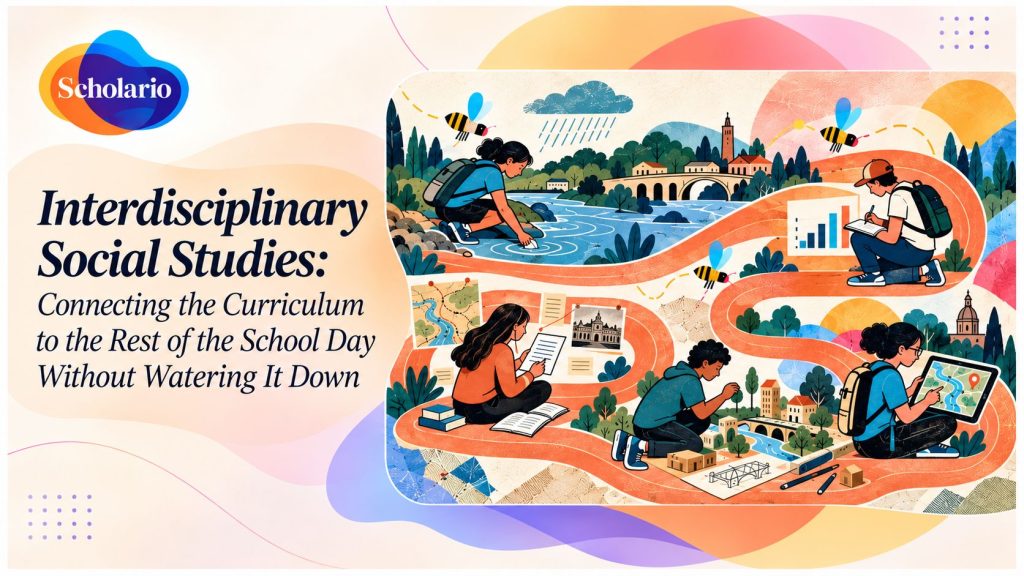
Picture a Grade 5 week. On Monday, students study ancient river civilisations in social studies. On Tuesday, they work on area and measurement in maths. On Wednesday, they learn about the water cycle in science. On Thursday, they write a persuasive letter about school lunches.
Every lesson might be excellent. But nobody tells the students that flooding rivers, measuring and dividing farmland, and arguing over who gets the water are parts of the same human story. The school day is organised like a building of separate rooms, and students walk through the corridors alone.
An interdisciplinary social studies curriculum is an attempt to open some doors. Done well, it helps students see that knowledge connects. Done badly, it produces a lot of activity and very little thinking.
The test for a genuine connection
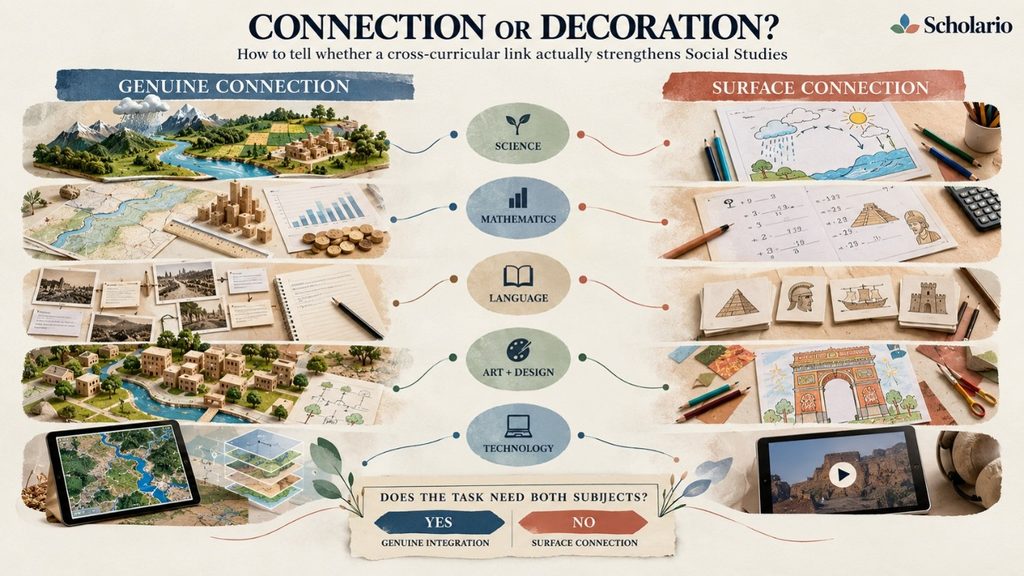
Most schools already have “cross-curricular links.” Many of them are decorative. Students draw a pyramid in art during the Egypt unit. They solve maths word problems that use pharaohs’ names. Nothing about social studies thinking is needed to complete the task.
A simple test helps: Could students answer the question well without both subjects? If yes, the link is decoration. If no, it is real integration. A question like “Why did early cities grow where they did, and was that a good choice?” genuinely needs geography, science, history and some economic reasoning. A pyramid drawing needs none of them.
Two layers of integration
Schools often mix up two different kinds of connection.
The inner layer is integration within social studies. History explains why a trade route mattered. Geography explains why it ran where it did. Economics explains what moved along it. Civics explains who controlled it. If these strands do not talk to each other, outward links will not fix the problem. This is fundamentally a question of social studies curriculum coherence [Blog 20 | Do Your History, Geography and Civics Strands Build on One Another? | Linked text: “social studies curriculum coherence”].
The outer layer is integration with the rest of the school day: science, maths, language, the arts and technology. This layer is harder, because it depends on other departments, calendars and teachers.
Design moves that make integration real
Start from a shared question, not a shared topic. Two teachers teaching “Egypt” at the same time is coordination. Two teachers helping students answer the same question is integration. Designing social studies around questions that connect disciplines gives every subject a reason to contribute.
Map the calendar. The best link fails if maths teaches graph reading three months after social studies needs it. Put term plans side by side and look for the handful of weeks where connections can actually land.
Choose a few strong links over many weak ones. One well-built project per term will teach more than twenty passing references. Sustainability is a natural starting point, because teaching sustainability through geography, economics and civic choices [Blog 48 | Teaching Sustainability Through Geography, Economics and Civic Choices | Linked text: “sustainability in the social studies curriculum”] draws on science and maths without forcing them.
Protect each subject’s thinking. Integration should never mean that history loses its evidence standards or that geography stops asking spatial questions. Each subject must bring its own way of reasoning to the table.
Put the link in the lesson plan. Teachers rarely have time to invent connections on their own. If a connection matters, it should appear in the plan, with a clear task. Language is the most practical place to start, because social studies and language arts links [Blog 11 | Using Social Studies Content to Strengthen Literacy Instruction | Linked text: “social studies and language arts links”] can strengthen both subjects at once.
Here is a question for any team reviewing its best cross-curricular project: If you removed the social studies part, would the project still work? If it would, what was social studies actually contributing?
A realistic note
Integration is easier in primary, where one teacher often teaches several subjects. In secondary, with specialist teachers and tight timetables, it usually means fewer and deeper touchpoints rather than constant connection. That is not failure. It is honest design.