
Why Media Literacy Belongs Inside the Social Studies Curriculum, Not a Separate Unit
Before school starts, a student has already seen a forwarded message in a family group chat. It claims a heritage site is closing, or that a heavy rain warning is fake, or that a famous figure said something they never said. It came as a voice note in one language and a screenshot in another. By lunchtime, three classmates have shared it.
A two-week “fake news” unit in Term 2 will not reach that moment. That is the core case for media literacy in the social studies curriculum: students need the skill every week, in the subject that already teaches them to question sources.
What the evidence shows
The most quoted study here is the Stanford History Education Group’s Evaluating Information: The Cornerstone of Civic Online Reasoning. Researchers collected 7,804 student responses across 12 US states. Their summary was blunt: young people’s ability to reason about online information “can be summed up in one word: bleak.”
Two findings are especially useful:
- More than 80% of middle school students believed a native advertisement labelled “sponsored content” was a real news story.
- When high school students were shown an unverified photo of unusual flowers, fewer than 20% questioned where it came from.
These are US students, and a school elsewhere should not assume identical results. The pattern is still worth taking seriously: students who are confident online are not always careful with evidence online.
The same skills, a different source
Notice what the Stanford study was named after: civic online reasoning, developed by a history education group. That is not an accident. Media literacy is source work applied to the present.
| Historical thinking skill | Same skill applied to today’s media | Where it lives in social studies |
| Sourcing: who made this and why? | Who posted this, and what do they gain? | History, civics |
| Context: when and where was it made? | Is this old footage shared as new? | History, geography |
| Corroboration: do other sources agree? | Checking other outlets before sharing | All strands |
| Perspective: whose view is this? | Same event, framed differently in two languages | Civics, values |
| Claim vs. evidence | Opinion presented as fact | Civics, economics |
| Reading maps and data | Misleading charts or cropped maps | Geography, economics |
When schools move these skills into a separate unit, three things tend to happen. The unit gets taught once and forgotten. It gets framed as a technology topic instead of a thinking skill. And students never see that the questions they ask of a historical letter are the same ones to ask of a viral post.
To see how primary-source skills build year on year, see [Blog 35 | Teaching Students to Read History Like Historians: Building a Source-Based Inquiry Curriculum | Linked text: “source-based historical inquiry”].
If students can evaluate a 200-year-old letter but not a message forwarded this morning, has the history curriculum finished its job?
A thread across the grades
- Grades 1–3: Is this story real or made up? Is this an opinion or a fact?
- Grades 4–6: Is this information or an advertisement? What is established, and what is only claimed?
- Grades 7–8: Who benefits from this message? How do two accounts of the same event differ?
- Grades 9–12: Checking a source by leaving it and searching others, questioning data visuals, and comparing coverage across languages.
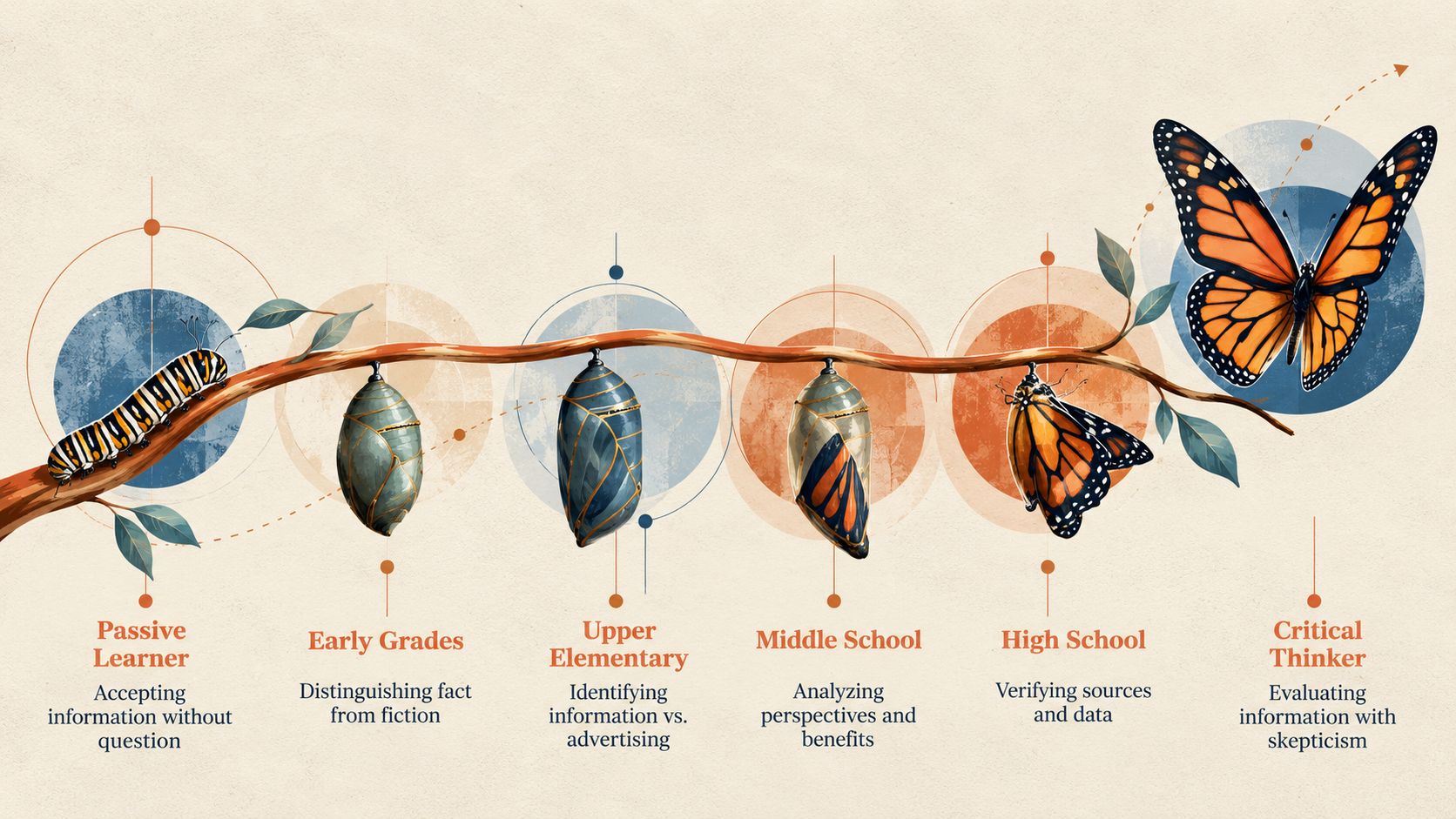
The thread also has a civic side. Evaluating a claim about national history or a public announcement is not disloyalty. It is how students protect shared facts from rumour. Framed well, media literacy strengthens trust in reliable institutions instead of weakening it. It also connects directly to how students argue in class. See [Blog 28 | Teaching Students to Reason and Argue Responsibly About Civic Issues | Linked text: “civic reasoning and argumentation skills”].
For the classroom mechanics of running a media check inside an inquiry lesson, see [Blog 46 | Where Media Literacy Fits in Social Studies Inquiry | Linked text: “media literacy within social studies inquiry”].
FAQs
Q: What is media literacy in the social studies curriculum?
A: It is teaching students to question who made a message, why, and with what evidence, using the same sourcing and corroboration skills social studies uses with historical documents.
Q: Why not teach media literacy as a separate unit?
A: Stand-alone units tend to be one-off and cut off from subject content. Built into social studies, the skills are practised all year on real topics.
Q: Which grade should media literacy start in?
A: Early. Grade 1 students can tell real from made-up stories. The skill then grows more demanding each year.
Q: Does media literacy conflict with teaching national identity?
A: No. Checking sources protects shared facts and reliable institutions from misinformation. It supports informed, confident citizenship.